3-Way Stopcocks, Extension Lines & Pressure Monitoring: Buyer Guide

A procurement guide to distinguishing stopcocks, stopcock extensions and high-pressure monitoring lines for hospital and distributor sourcing.

Hospital infusion and monitoring catalogues often place 3-way stopcocks, stopcocks with extension tubing and pressure-monitoring lines near each other. They may be used in connected workflows, but they are not the same product. For procurement teams, biomedical engineers and distributors, the safest approach is to define the exact function, connector arrangement, line construction, length and compatibility before comparing price.

This guide explains the procurement differences among these products using current Sicher Medik documentation for Triofluss®, Triofluss Plus® and Weglink®. It does not provide clinical-use instructions.

Three product categories that should not be merged

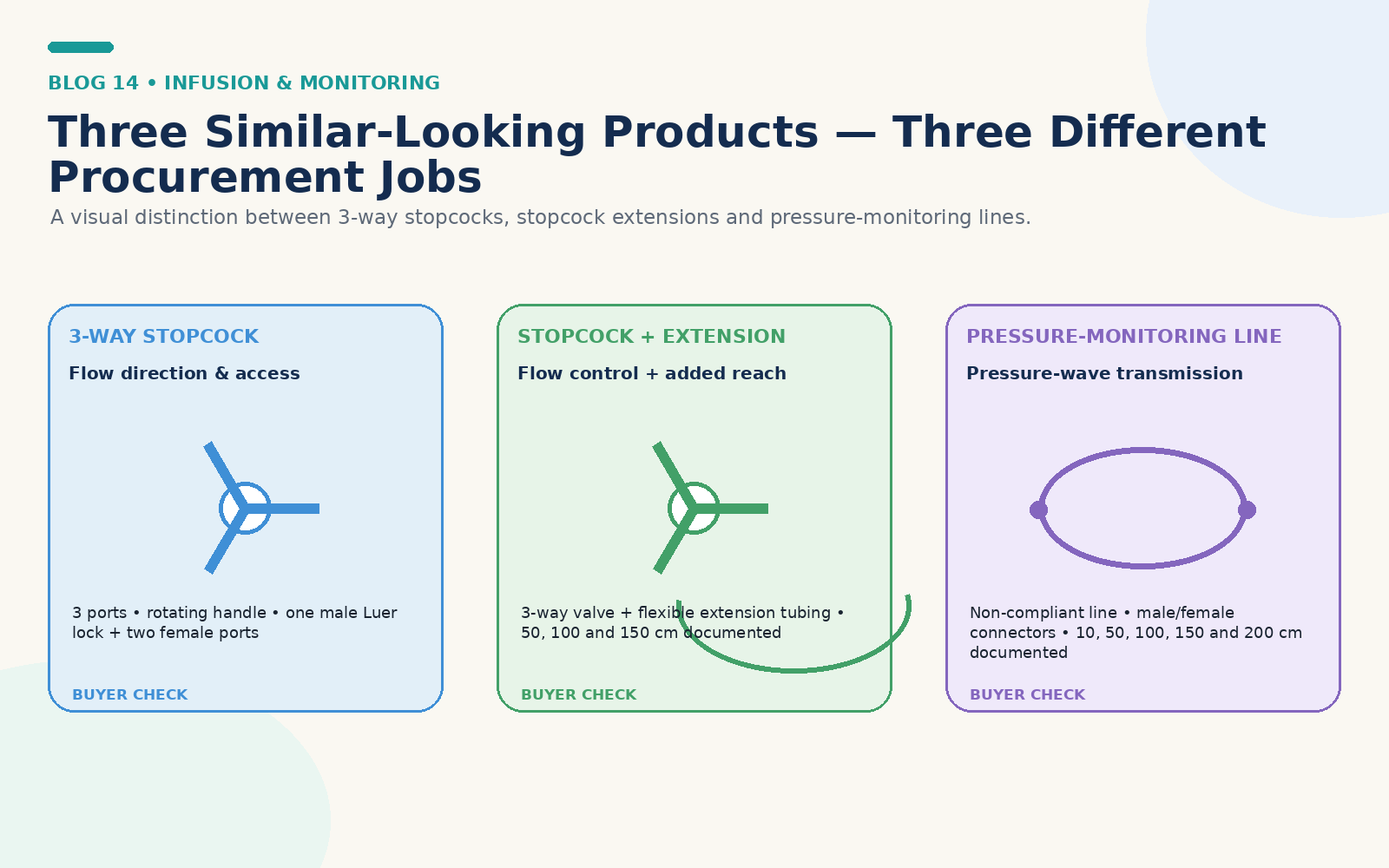
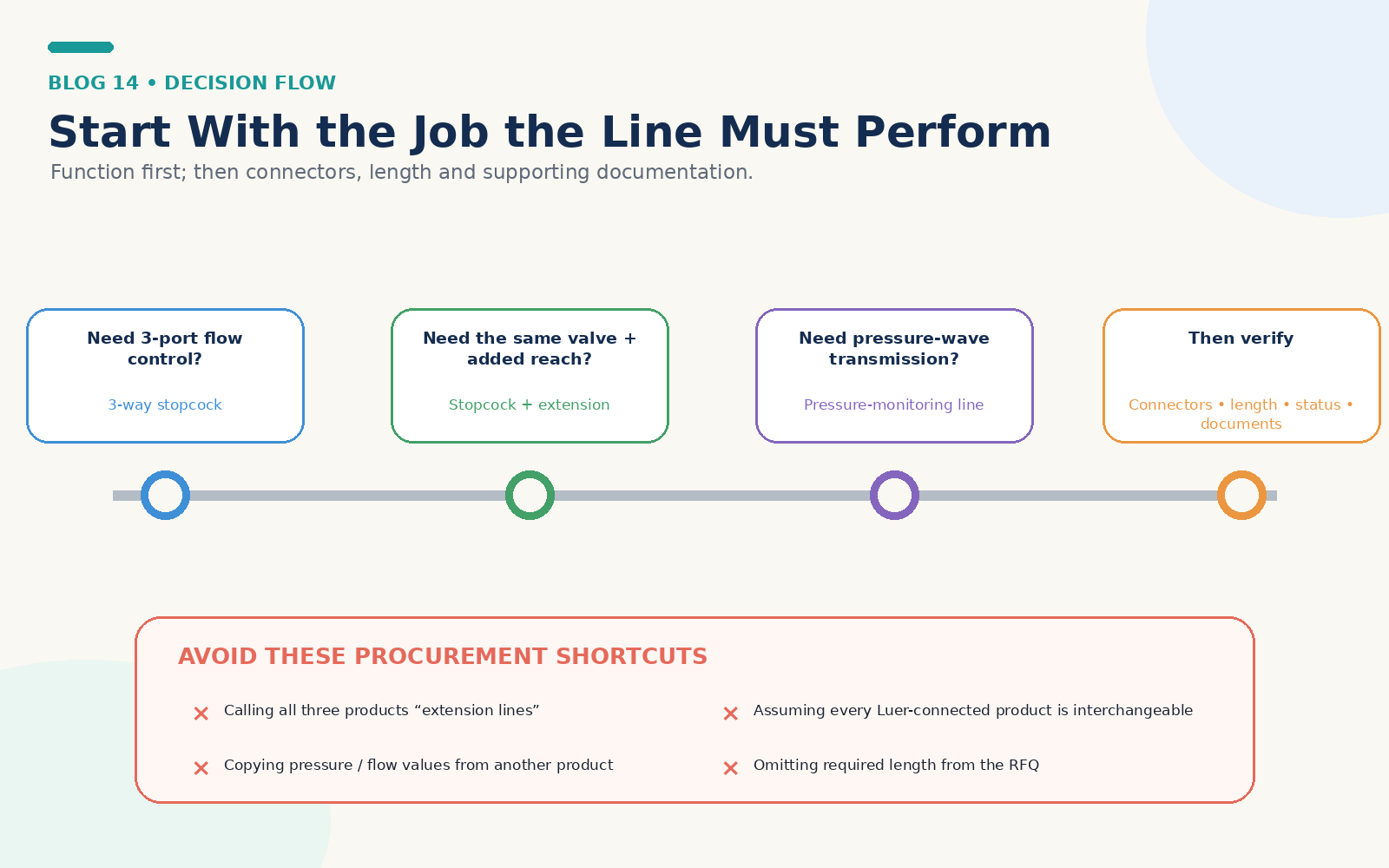
A 3-way stopcock is a three-port valve used to control and direct fluid between connected lines. A 3-way stopcock with extension combines that valve with flexible extension tubing. A pressure-monitoring line is a distinct high-pressure, non-compliant line intended for pressure-wave transmission between an invasive catheter and pressure transducer.

1. 3-way stopcock: focus on ports and flow control

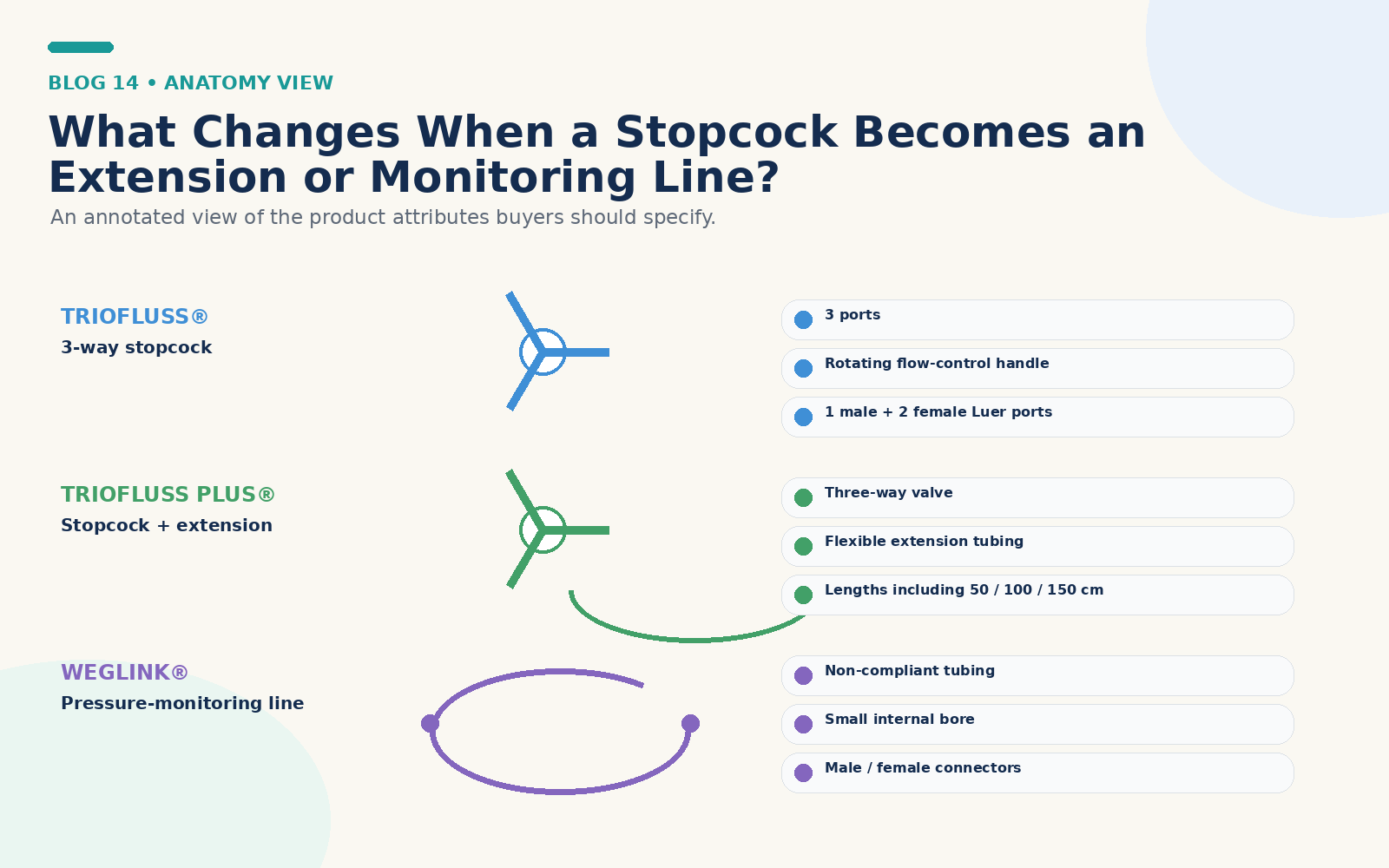
Sicher Medik’s Triofluss® is documented as a sterile, single-use three-way stopcock made from medical-grade ABS. The product information lists a three-port stopcock valve, rotating flow-control handle, one male Luer lock and two female ports.

When preparing an RFQ, buyers should confirm the port arrangement, connector type, sterility, use status and compatibility with the intended line setup. Avoid assuming pressure performance figures or chemical-resistance values unless they are stated in the current technical sheet.

2. Stopcock with extension: specify tubing as well as the valve

Triofluss Plus® adds flexible extension tubing to the three-way stopcock. The current CMS lists medical-grade PVC and ABS and documents extension lengths such as 50 cm, 100 cm and 150 cm, while also advising buyers to confirm current availability before procurement.

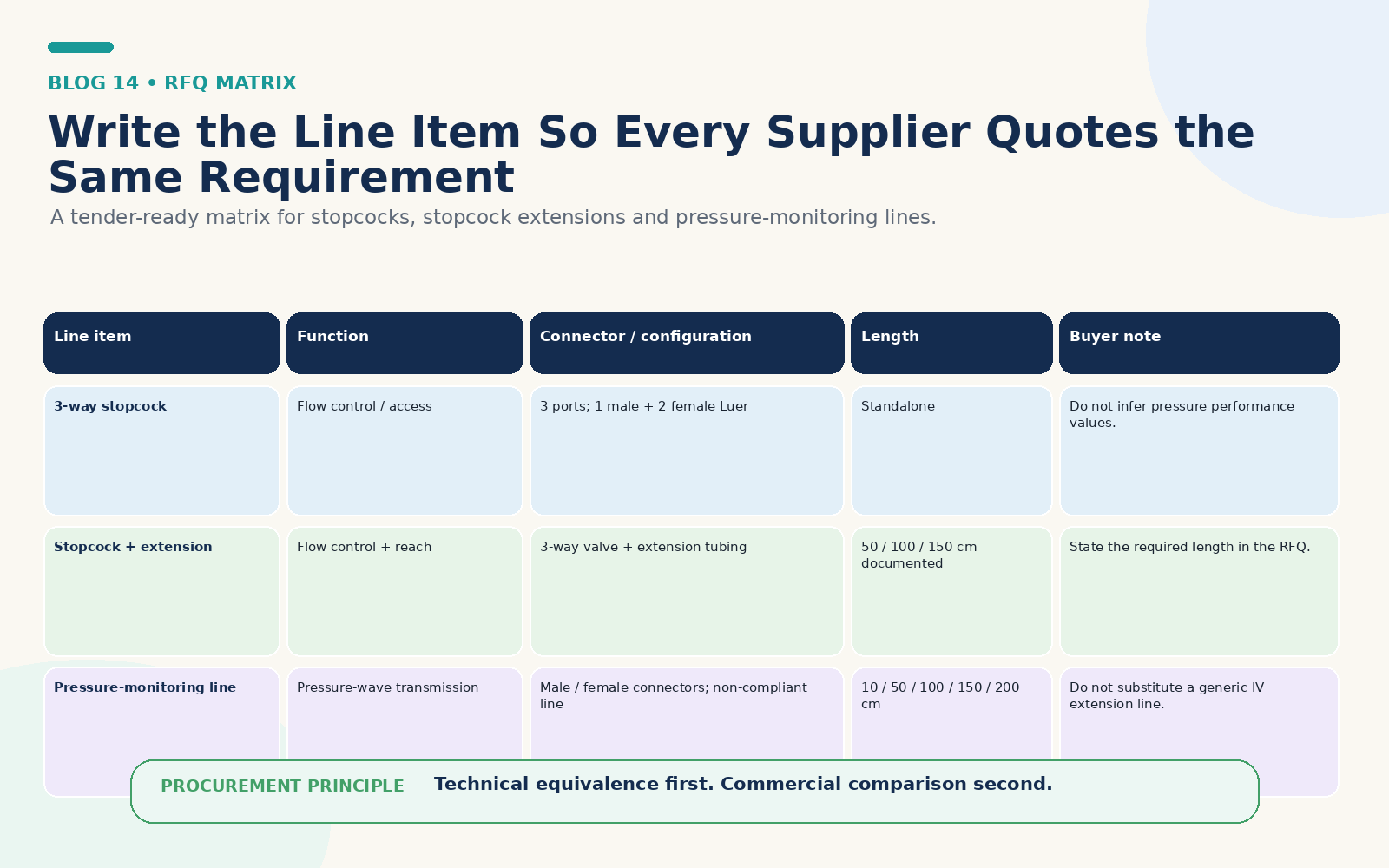
This means the RFQ should specify both the valve requirement and the required extension length. A generic request for “3-way extension” can lead to mismatched quotations if suppliers assume different tubing lengths.

3. Pressure-monitoring line: treat it as a separate high-pressure category

Weglink® is documented as a sterile, high-pressure, non-compliant pressure-monitoring line. Its current product information lists rigid kink-resistant tubing, a small internal bore designed to maintain pressure integrity and signal clarity, male and female connectors, transparent medical-grade PVC and latex-free materials.

Available documented lengths are 10 cm, 50 cm, 100 cm, 150 cm and 200 cm. Procurement teams should not substitute a low-pressure IV extension set for a pressure-monitoring line merely because both products use tubing and Luer connections.
Comparison infographic for 3-way stopcock, stopcock extension and pressure-monitoring lineDecision-flow infographic for selecting stopcock, extension or pressure-monitoring line

4. Build separate specifications for each line item

A clear tender can use three separate line items: standalone 3-way stopcock, 3-way stopcock with extension tubing, and pressure-monitoring line. For each item, state the generic name, connector configuration, required length where applicable, sterility, use status, material only where required, packaging, quantity and documentation requirements.

This structure reduces ambiguity and makes vendor comparisons easier because each supplier is responding to the same defined requirement.

5. Verify compatibility with the hospital’s approved setup

Connector compatibility matters across infusion and monitoring systems. Procurement teams should work from an approved clinical or biomedical specification and then confirm that the offered device matches that requirement. Do not assume that every Luer-connected product is interchangeable in every workflow.

6. Avoid unsupported pressure and performance claims

If a tender asks for burst pressure, priming volume, compliance, flow rate or another numerical performance parameter, request the current technical documentation for the exact model. Do not copy a generic industry figure or a competitor value into a specification for Triofluss®, Triofluss Plus® or Weglink® unless it is verified for that product.

7. Supplier qualification and repeat-order control

Sicher Medik manufactures under an ISO 13485:2016 certified quality management system and at a CDSCO-licensed medical device manufacturing facility in India. Buyers should still retain the current product specification, applicable regulatory documents, quotation and approved pack details for each SKU.

For repeat orders, record the exact stopcock configuration or monitoring-line length rather than using a broad category description. This helps prevent specification drift over time.

8. Compare commercial terms after the technical match

Once the technical requirement is aligned, compare MOQ, packing quantity, lead time, freight, taxes, payment terms and delivery schedule. For multi-location hospital groups, specify whether deliveries are centralized or split across facilities.

Frequently asked questions

Is a pressure-monitoring line the same as an IV extension line?

No. Weglink® is documented as a high-pressure, non-compliant pressure-monitoring line intended for pressure-wave transmission. It should not be treated as a generic low-pressure IV extension set.

What lengths are documented for Weglink®?

The current Sicher Medik product information lists 10 cm, 50 cm, 100 cm, 150 cm and 200 cm.

What lengths are available for Triofluss Plus®?

The current CMS documents various extension lengths including 50 cm, 100 cm and 150 cm, with current availability to be confirmed before ordering.

What connectors are documented for Triofluss®?

The current product information lists one male Luer lock and two female ports.

Can these products be considered for OEM or private-label supply?

Eligible bulk requirements can be discussed with Sicher Medik, subject to product, quantity, technical feasibility and commercial agreement.

Anatomy infographic showing how stopcock, extension and pressure-monitoring line specifications differRFQ comparison matrix infographic for stopcocks, extensions and pressure-monitoring lines

Conclusion: separate the valve, extension and monitoring-line requirements

Procurement becomes clearer when 3-way stopcocks, stopcocks with extension tubing and pressure-monitoring lines are treated as distinct product categories. Define the required function, connectors and length first, then compare supplier documentation and commercial terms.

Hospital and distributor buyers can review Triofluss®, Triofluss Plus® and Weglink® for current product information and B2B enquiries.