
French Size Guide for Catheters and Feeding Tubes in India
A hospital buyer’s reference for Fr sizing, product differences, tender specifications and bulk sourcing.
French size is one of the most important identifiers when hospitals buy urinary catheters, suction catheters, nasogastric tubes and infant feeding tubes. Yet a size number alone does not establish that two devices are interchangeable. Procurement teams should combine the French-size designation with the generic product name, intended use, length, tip configuration, material and relevant product documentation.
This practical guide is intended for hospital purchasing departments, nursing stores, distributors, dealers, tender teams and healthcare procurement groups in India. It is not guidance for clinical device selection, insertion or treatment. Qualified clinical teams must approve the appropriate device and size for each application.
What does Fr mean on a catheter or feeding tube?
French gauge, usually abbreviated Fr or FG, describes the nominal outside diameter of a tube. Under the conventional relationship, outside diameter in millimetres is approximately French size divided by three. For example, 6 Fr corresponds to about 2 mm nominal outside diameter, and 12 Fr to about 4 mm. This is a dimensional reference, not a measure of lumen diameter, flow performance, wall thickness or patient suitability. Actual tolerances and design details must be checked against the manufacturer's current specification.
Why French size alone is not a complete tender specification
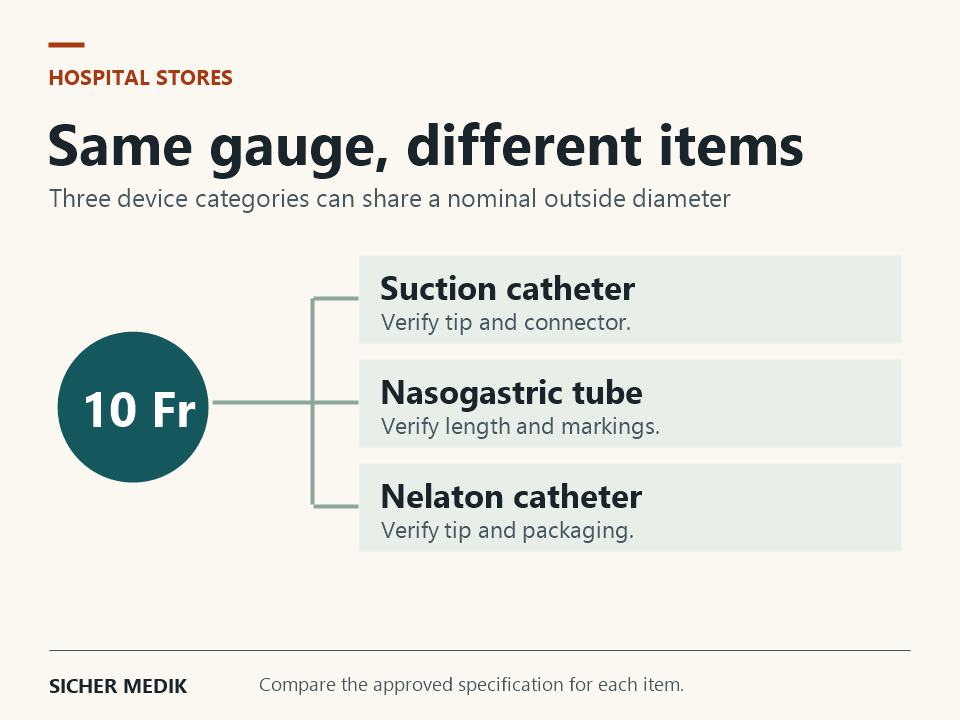
A 10 Fr suction catheter, a 10 Fr nasogastric tube and a 10 Fr urinary catheter may have a similar nominal outside diameter while serving different intended purposes. They may differ in length, openings, tip design, connectors, packaging, instructions and regulatory documentation. Tender teams should never treat these product categories as substitutes merely because the Fr number matches.
Suction catheters: confirm the device category first
Sicher Medik's Spiracath suction catheter range lists sizes from 5 Fr to 18 Fr. When requesting a quote, state the generic name 'suction catheter' and the required Fr sizes as separate line items. Confirm the approved tip and connector requirements, usable length, packaging, sterility designation and relevant documents for the specific model. Do not infer suction performance or compatibility with equipment from the French-size number alone.
Nasogastric tubes: use a separate approved specification
The Rylex nasogastric tube range lists 6 Fr through 18 Fr. Buyers should record each approved size separately and verify the product's documented length, tip and connection arrangement, markings and supplied packaging. A nasogastric tube is not interchangeable with an infant feeding tube or suction catheter simply because their sizes overlap.
Infant feeding tubes: identify the approved variant precisely
Sicher Medik's Kleinline infant feeding tube range lists 5 Fr to 10 Fr, with a documented 50 cm length. Procurement descriptions should distinguish the intended infant feeding tube from other enteral devices. Confirm the exact product specifications and applicable labelling before issuing an order. French size does not establish clinical suitability for any age or condition.
Nelaton catheters: avoid mixing urinary and other tubing categories
Sicher Medik's Veracath Nelaton catheter range lists sizes from 6 Fr to 24 Fr. In purchase orders, specify 'Nelaton catheter' and the approved size rather than 'catheter 12 Fr' alone. Verify length, tip arrangement, packaging, sterility and intended-use information for the exact quoted product. Do not assume a colour coding system or connector configuration without verified model-specific evidence.
How to build a French-size reference sheet
Create a controlled procurement register with columns for generic name, approved manufacturer and brand, Fr size, approved length, model or SKU, intended-use category, packaging unit, applicable documents, and last specification review date. If the same Fr size appears in multiple categories, retain separate rows. Use the manufacturer's latest specification and clinical department approval as the source of truth.
Use millimetre conversions carefully
The Fr-to-mm relationship can help a buyer understand nominal external dimensions, but it should not replace the actual manufacturer's dimensional tolerances. Never calculate internal diameter or flow from Fr alone: wall thickness, material and design differ. Where compatibility is essential, obtain the exact technical drawing or specification and have the qualified team review it.
Packaging, sterility and traceability checks
For every device category, ask suppliers to identify whether the quoted product is supplied sterile or non-sterile, single-use or reusable, and what the current label and instructions state. Verify lot or batch identification, packing quantity, storage information and expiry information where applicable. Do not assume that every item within a brand or category has identical packaging or sterilisation details.
Tender comparison and sample approval
Compare like-for-like product categories and configurations, not merely the lowest price per tube. Include the generic name, exact Fr sizes, required lengths, packaging, technical documents, approved sample requirements, delivery destination and supply schedule. If alternatives are permitted, record deviations explicitly and obtain technical approval before purchase.
Distributor and multi-hospital inventory planning
For a distributor or hospital chain, a consistent size matrix can reduce confusion during quotation, receiving and replenishment. Separate frequently used sizes from exceptional requirements and calculate reorder quantities using actual historical consumption. Standardisation may improve inventory control, but savings and service outcomes should be measured locally rather than guaranteed.
Quality and regulatory documentation
Sicher Medik reports over ten years of medical-device manufacturing experience, an ISO 13485:2016 certified quality management system and a licensed manufacturing facility in Kerala. Buyers should still request the current product-specific documents and verify applicable regulatory requirements for the exact quoted item. Quality-system certification does not by itself prove clinical suitability or replace product-level compliance evidence.