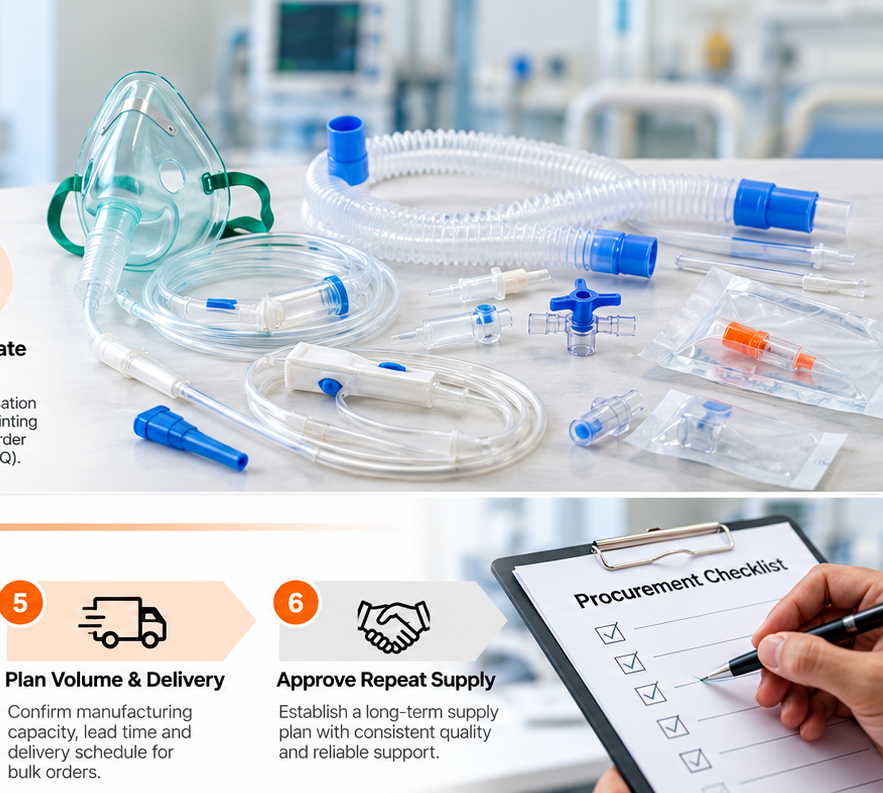
Hospital Consumables Bulk Procurement Checklist for India

A practical B2B checklist for hospitals, distributors and institutional buyers evaluating medical disposable suppliers

Bulk procurement of hospital consumables is not only a price-comparison exercise. For hospitals, distributors, institutional buyers and tender teams, a stronger purchasing decision starts with a clear product specification and then checks the supplier, documentation, packaging, supply plan and commercial fit.

This checklist is designed for buyers evaluating frequently reordered medical disposables in India. It focuses on practical questions that can be applied to respiratory, infusion, surgical, critical-care, gastro and urology consumables without assuming that every product has the same regulatory, sterility or packaging requirements.

1. Define the exact product before requesting a quotation

Start with the generic device name and the configuration your facility actually needs. A useful requirement normally identifies the product type, intended use, size or capacity where relevant, sterility status, single-use or reusable status, packaging needs, connectors or accessories, expected quantity and delivery destination.

For example, buyers comparing intravenous infusion sets should specify the required configuration rather than requesting an IV set alone. Buyers sourcing oxygen masks or nasal cannulas should similarly identify the required patient size and other documented configuration requirements.

2. Verify the regulatory status applicable to the device

Medical-device procurement should distinguish between a manufacturer’s facility-level credentials and the regulatory status applicable to the particular product. Request current documentation and check what is relevant to the device being purchased rather than relying on broad marketing statements.

In India, medical devices are regulated under the Drugs and Cosmetics Act and the Medical Devices Rules, 2017. Procurement teams should therefore make regulatory verification part of supplier qualification, particularly for institutional purchases, tenders and long-term supply arrangements.

3. Review the manufacturer’s quality-management system

Quality-system information helps procurement teams understand how a supplier manages documented processes, production controls, records and corrective actions. ISO 13485 is the quality-management-system standard specifically associated with medical-device organizations.

Sicher Medik operates under an ISO 13485:2016 certified quality management system and manufactures at a CDSCO-licensed medical device manufacturing facility in India. Product-specific requirements should still be checked against the current applicable specification and procurement documentation.

4. Match the specification to the clinical and purchasing requirement

Do not treat similar-looking disposables as interchangeable without checking their documented configuration. Dimensions, connectors, chamber capacities, tubing lengths, filters, sterility and other characteristics can differ by model.

For instance, the Sicher Medik burette set range documents measured-volume configurations, while the blood transfusion set has a different intended procurement requirement. Respiratory buyers may need to distinguish among a ventilator circuit, breathing filter and catheter mount.
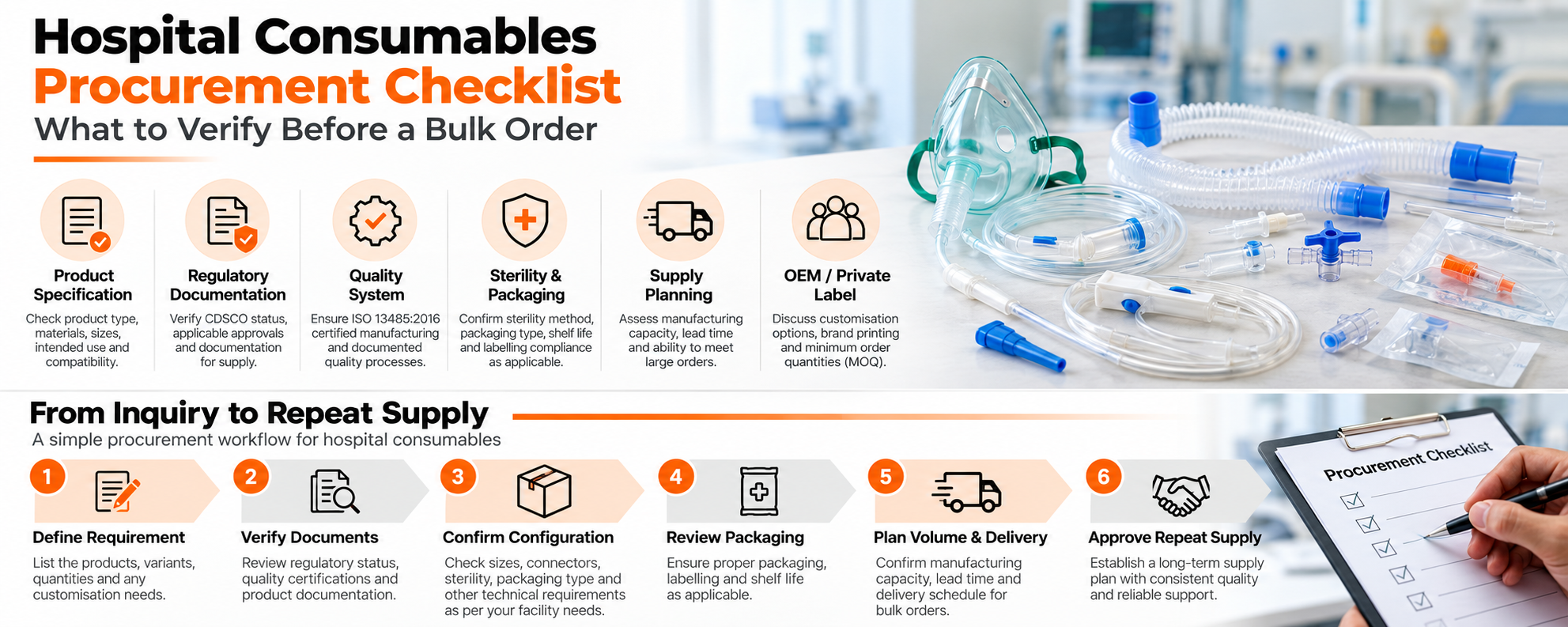
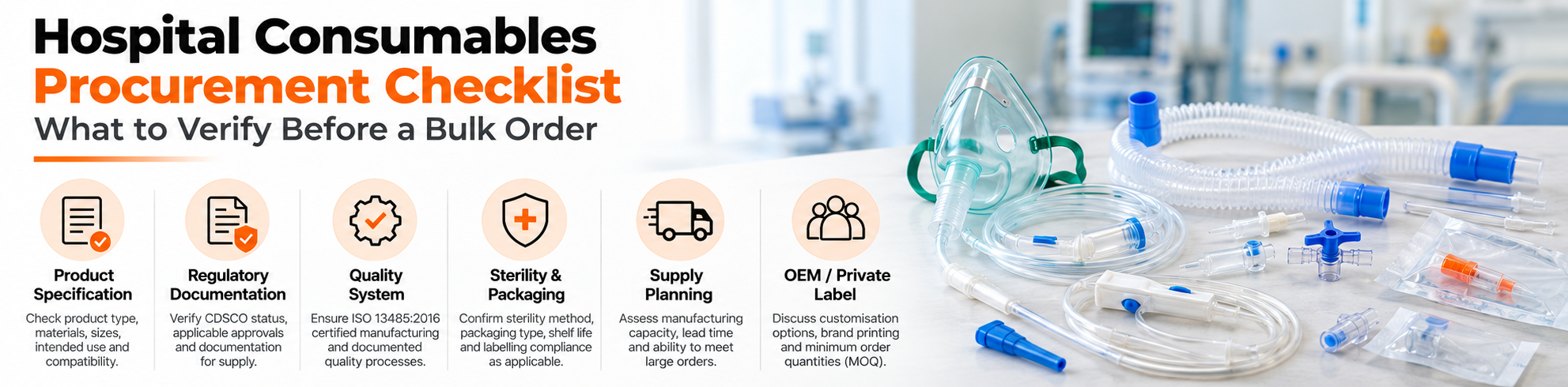
Hospital consumables procurement checklist infographic for bulk medical disposable sourcing in IndiaProcurement verification checklist for hospital consumables including specifications, documents, quality, packaging and supply planning

5. Confirm sterility and packaging rather than assuming them

Hospital consumables are not all supplied with the same sterility status. The purchase specification should state whether the required configuration is sterile or non-sterile and should be checked against the manufacturer’s current documentation.

Packaging should also be reviewed as part of procurement. Confirm the individual pack, secondary packaging, label information, carton arrangement and any requirements for institutional, distributor or export supply. Where shelf-life or storage information is needed, request the current documented value rather than estimating it.

6. Assess repeat-supply capability before placing a large order

A sample or first shipment can confirm the requested configuration, but institutional procurement depends on repeatability. Discuss forecast quantities, order frequency, lead-time expectations, delivery destinations and tender-driven peaks before onboarding a supplier for recurring purchases.

This is especially relevant for high-use categories such as suction catheters, Yankauer suction sets, nasogastric tubes and other regularly replenished hospital consumables.

7. Build a quotation request that suppliers can answer accurately

A detailed RFQ reduces back-and-forth and makes competing quotations easier to compare. Include the generic product name, required configuration, quantities, destination, required documents, packaging preference, expected purchasing frequency and target timeline. If several products are being sourced together, list each line separately.

For hospitals and distributors in Kerala, identify the delivery location and whether the requirement is a one-time purchase, recurring institutional supply, distributor stock or a tender-linked order. Sicher Medik supports B2B enquiries across India, including Kerala, subject to product availability and mutually agreed commercial terms.

8. Discuss OEM and private-label requirements before production planning

Distributors, importers and brand owners should raise private-label requirements at the beginning of the sourcing process. Branding, artwork, packaging, labels, quantities and market-specific documentation can affect feasibility and commercial planning.

Sicher Medik supports OEM and private-label manufacturing for eligible bulk orders, subject to quantity, technical feasibility and commercial agreement. No particular customization should be assumed until it has been reviewed and agreed.

9. Keep a supplier-qualification record

For repeat procurement, retain the approved specification, current supplier documents, quotation, packaging confirmation and any agreed commercial conditions. This makes future reorders easier to compare and reduces the risk of specification drift between enquiries.

Frequently asked questions

What information should a hospital include in a consumables RFQ?

Include the generic product name, configuration, required size or capacity where relevant, quantity, sterility requirement, packaging preference, delivery destination, required procurement documents and expected ordering schedule.

Should buyers verify CDSCO information when sourcing medical devices in India?

Yes. Buyers should verify the current regulatory status and documentation applicable to the manufacturer and the specific device being procured under India’s medical-device regulatory framework.

Why is ISO 13485 relevant to medical-device procurement?

ISO 13485 is a quality-management-system standard for medical-device organizations. It can be an important supplier-qualification factor, but it does not replace verification of product-specific requirements.

Should sterility be assumed for a disposable medical product?

No. Disposable and sterile are different attributes. Confirm the documented sterility status for the exact product and configuration being ordered.

Can hospital consumables be sourced under an OEM or private label?

OEM or private-label supply may be available depending on the manufacturer, product, quantity, technical feasibility, packaging and commercial agreement. Requirements should be discussed before production planning.

What should distributors confirm before setting up repeat supply?

Confirm the approved specification, expected volumes, packaging, documentation, order frequency, delivery destinations, lead-time expectations and the commercial process for repeat orders.

Hospital consumables procurement workflow from defining requirements to repeat supply approvalMedical consumables procurement visual for hospital and distributor bulk sourcing

Conclusion: procure against a documented checklist

The most useful hospital-consumables procurement checklist converts a general enquiry into a documented requirement. Define the product, verify applicable supplier and regulatory information, check the exact configuration, confirm sterility and packaging, plan repeat supply and discuss OEM requirements early where relevant.

Sicher Medik is an Indian medical-device manufacturer with more than 10 years of manufacturing experience, an ISO 13485:2016 certified quality management system and a CDSCO-licensed medical device manufacturing facility. Hospitals, distributors, institutional buyers, export customers and eligible OEM/private-label buyers can contact Sicher Medik for current product specifications, documentation and B2B quotations.