ISO 13485:2016 in Hospital Tenders: What Buyers Should Verify

A supplier-qualification guide for hospital groups, distributors and tender teams evaluating medical-device manufacturers.

ISO 13485:2016 is one of the most frequently requested quality-system standards in medical-device procurement. For hospital groups, distributors and tender teams, however, the certificate should be used correctly: it is evidence of a medical-device quality management system, not automatic approval of every product and not a substitute for the regulatory documents applicable to the device being purchased.

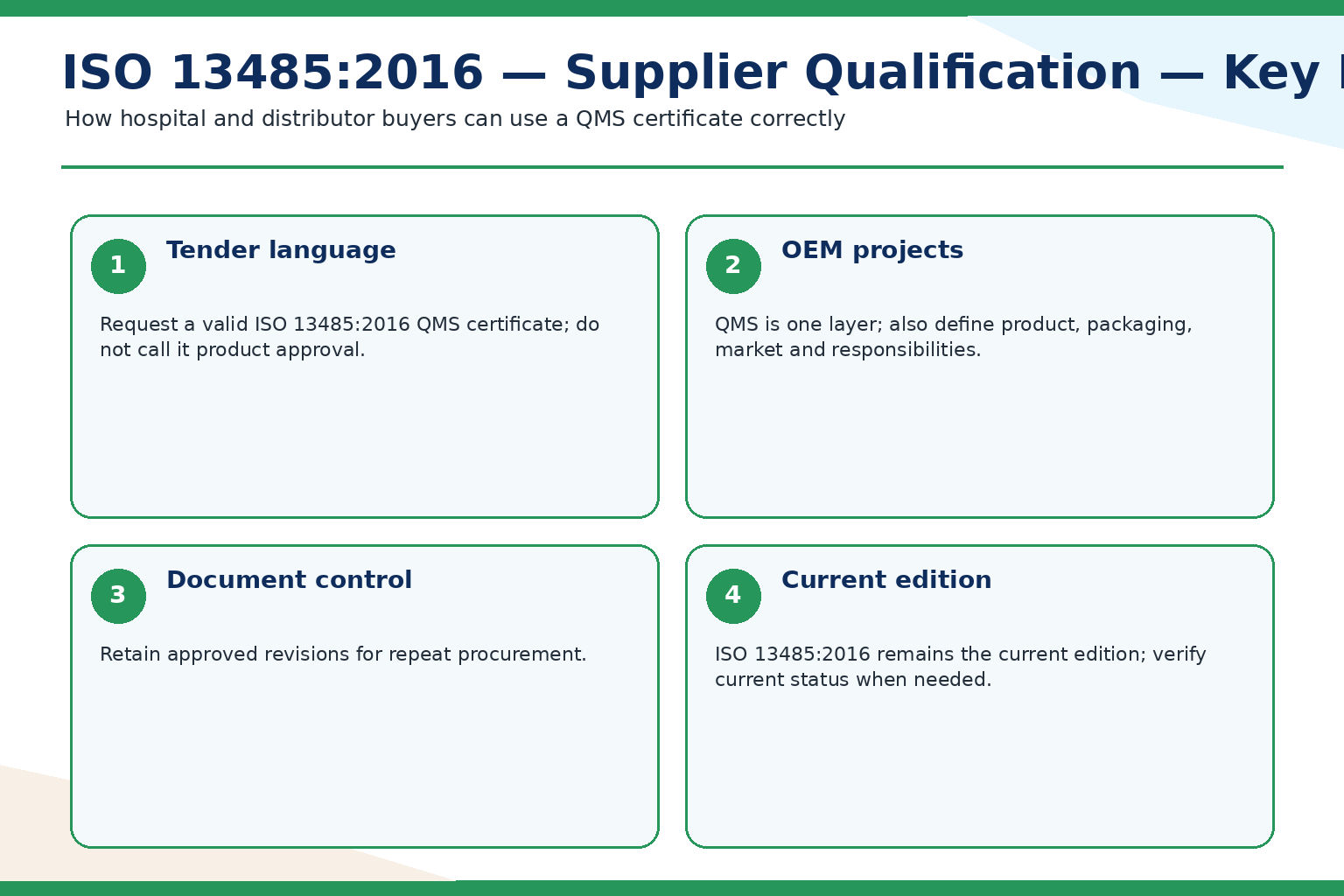
ISO confirms that ISO 13485:2016 was reviewed and confirmed in 2025 and remains the current edition. This guide explains how procurement teams can use the standard as one part of supplier qualification.

What ISO 13485 actually covers

ISO 13485 specifies quality-management-system requirements for organisations involved in medical devices. The framework addresses controlled processes, documentation, responsibilities, risk-related quality activities, production and service controls, corrective action and other elements relevant to consistent medical-device operations.

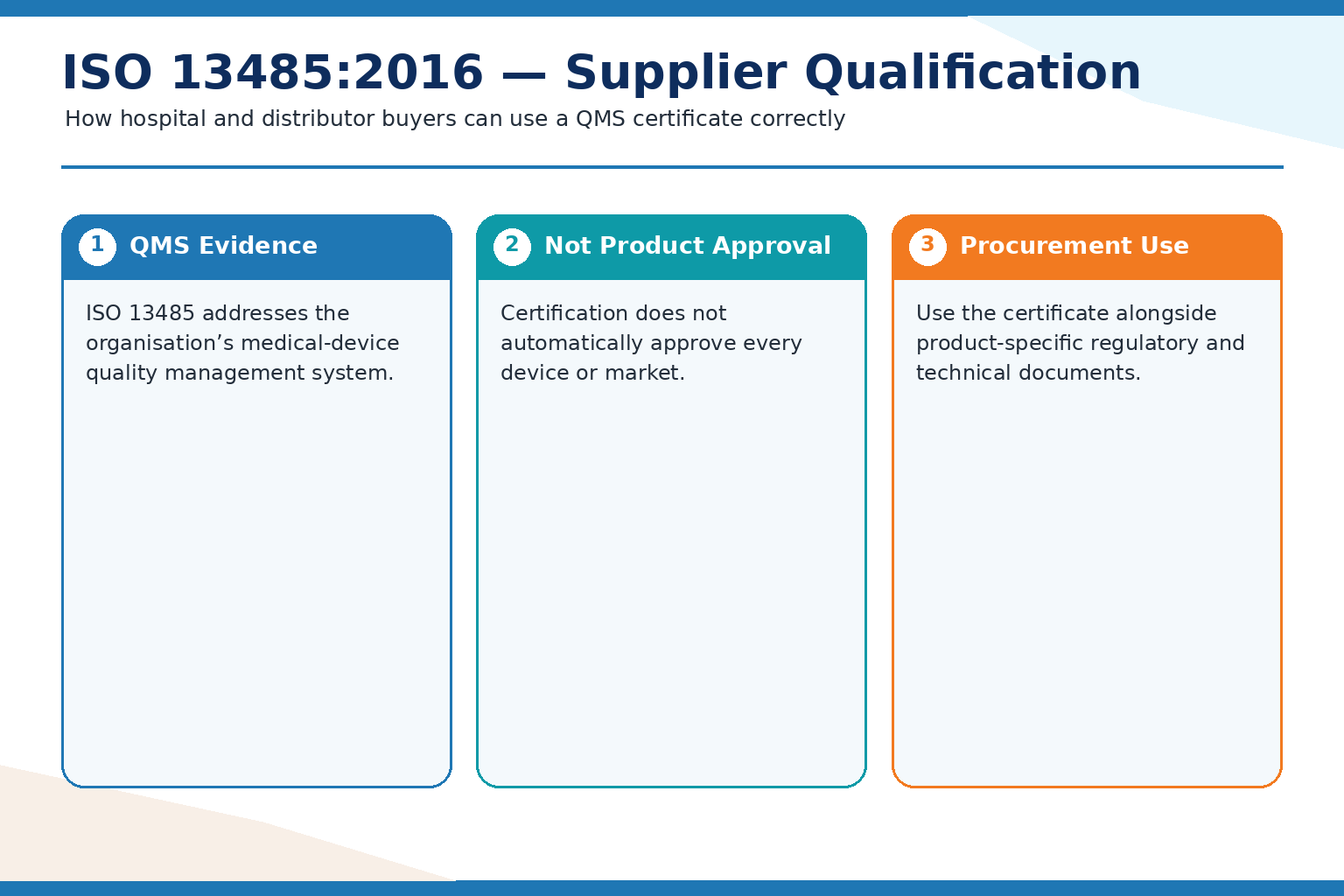
For buyers, the important point is that certification applies to the organisation and its certified scope. It does not automatically prove that every device in a catalogue is licensed for every market or meets every tender specification.

1. Check the certificate holder and scope

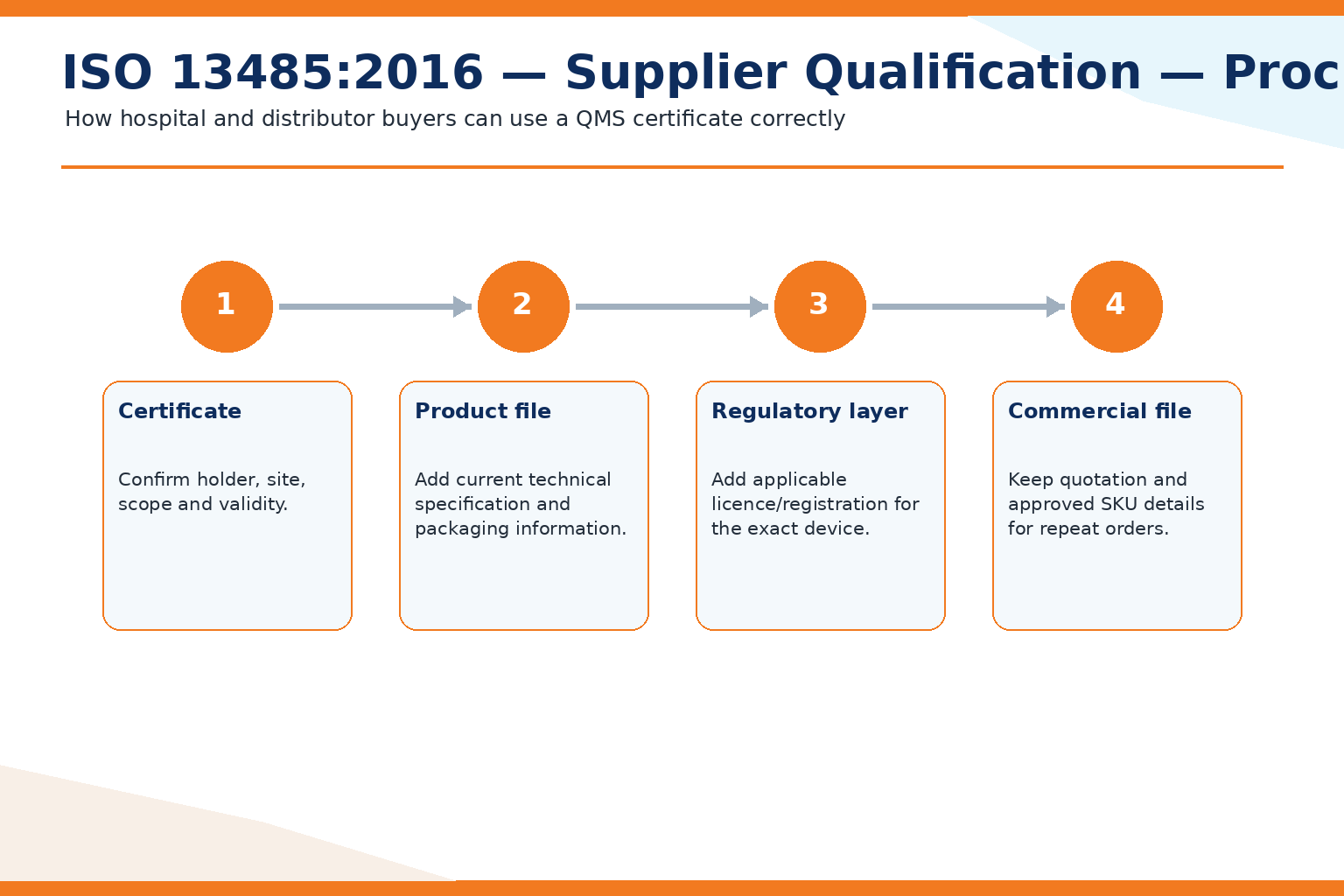
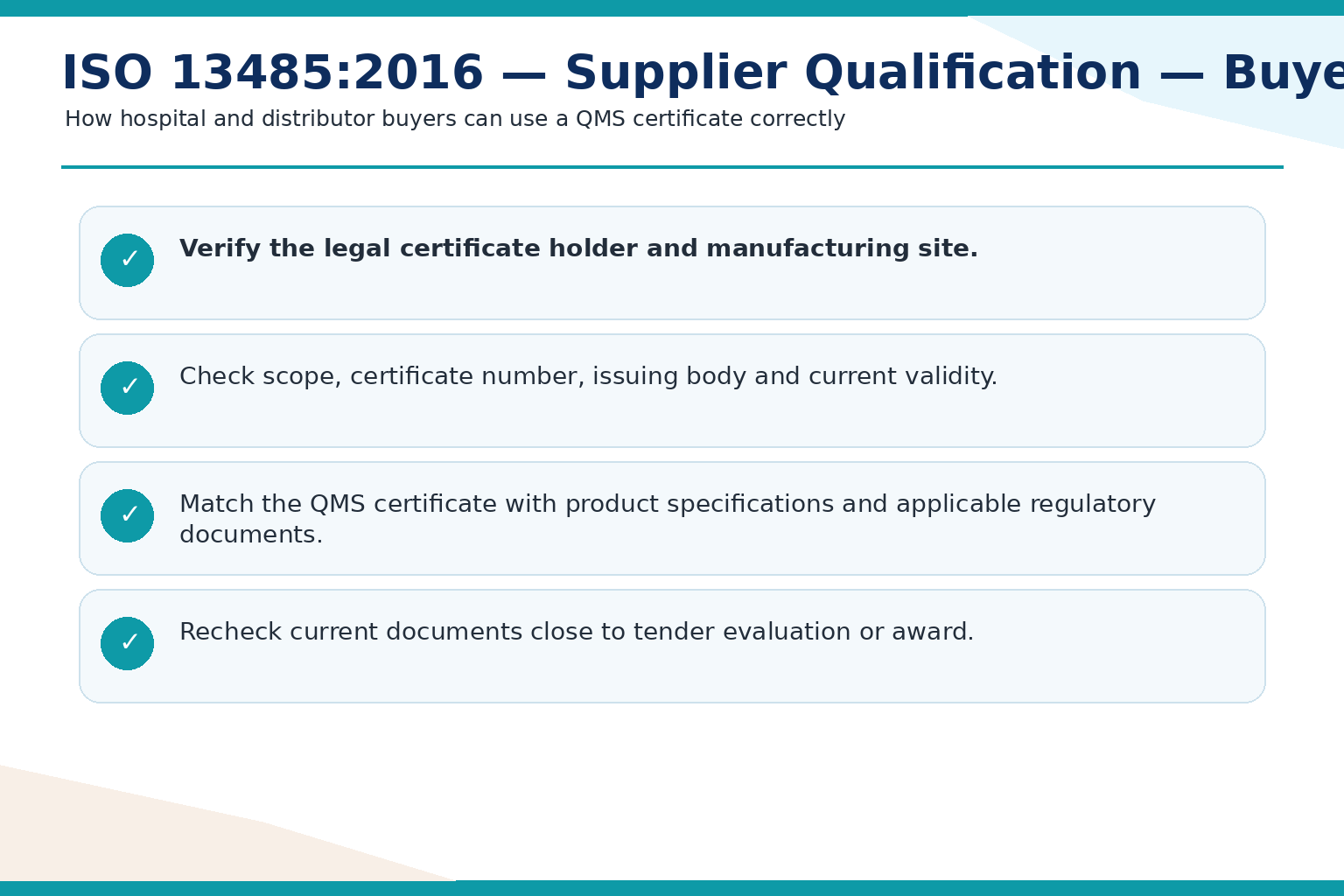
Start by confirming that the legal entity named on the certificate matches the supplier or manufacturer being evaluated. Review the certified address, scope statement, certificate number, issuing certification body and validity information. If a distributor is quoting a third-party product, the manufacturer’s relevant documents should also be identifiable.

Sicher Medik states that it is ISO 13485:2016 certified under certificate number RQMD91/12138. Institutional buyers can request the current certificate during supplier qualification.

2. Match the manufacturing site to the procurement record

A hospital tender may require evidence that the proposed product comes from the evaluated manufacturing site. Keep the manufacturer address and applicable licence information with the quality certificate so the audit trail is clear.

Sicher Medik manufactures at its medical-device facility in Kanjikuzhi, Alappuzha, Kerala, India and states that the facility is licensed for medical-device manufacturing under the applicable Indian regulatory framework.

3. Keep ISO 13485 separate from product approval

One of the most common procurement mistakes is to treat an ISO 13485 certificate as if it were a product registration or licence. These are different layers. The QMS certificate supports assessment of the manufacturer’s quality system, while the applicable product-specific regulatory evidence depends on the device and market.
ISO 13485 supplier qualification infographic for hospital tendersISO 13485 certificate verification checklist for medical device procurement

4. What hospital tender teams can verify in addition

Alongside the ISO 13485 certificate, procurement teams can request the current product specification, applicable licence or registration documents, label/packaging information, sterility status where relevant, instructions for use where applicable, quotation, packing configuration and any tender-specific declarations.

This combination gives the buyer a clearer picture than relying on a single certificate.

5. Why document control matters for repeat supply

Medical-device procurement often involves recurring orders. Supplier qualification is stronger when the approved product specification, revision status, pack details and quality documents are retained in the purchasing record. If a specification or packaging revision occurs, the buyer can compare the change against the approved baseline.

6. ISO 13485 and OEM/private-label evaluation

For OEM or private-label projects, the quality-system review becomes part of a broader feasibility assessment. Buyers should also define the exact product, branding scope, packaging, destination market, quantities and regulatory responsibilities. A QMS certificate does not by itself authorise a private-label product in every market.

7. Avoid tender wording that overstates the certificate

Safer tender language asks for a valid ISO 13485:2016 quality-management-system certificate from the relevant manufacturer, together with applicable product-specific regulatory documentation. Avoid wording that says the certificate “approves” the product or guarantees clinical performance.

8. Check validity close to the award date

Certificates can be renewed, reissued or updated. For major contracts, verify the current certificate close to technical evaluation or award rather than relying on an old PDF saved from a previous tender.

Frequently asked questions

Is ISO 13485:2016 still current?

Yes. ISO states that the 2016 edition was reviewed and confirmed in 2025 and remains current.

Does ISO 13485 certify an individual medical device?

No. ISO 13485 is a quality-management-system standard for organisations. Product-specific licensing, registration and technical requirements must be checked separately.

What should a hospital verify on an ISO 13485 certificate?

Check the legal certificate holder, site/address, scope, certificate number, issuing body and validity information, and match these against the proposed manufacturer.

Can ISO 13485 be used in tender supplier qualification?

Yes. It can be an important quality-system criterion, but it should be used together with the applicable product and regulatory documents.

What ISO 13485 certificate does Sicher Medik state it holds?

Sicher Medik states that it is ISO 13485:2016 certified under certificate number RQMD91/12138. Buyers should request the current certificate for formal procurement use.

Medical device supplier qualification workflow using ISO 13485 and product documentsKey procurement points for ISO 13485 quality management system verification

Conclusion: use ISO 13485 as one layer of supplier qualification

ISO 13485 is valuable because it gives procurement teams a structured quality-system criterion for evaluating medical-device manufacturers. The strongest tender process combines that evidence with current product specifications, applicable licences or registrations, packaging information and commercial terms.

Hospitals, distributors and institutional buyers can contact Sicher Medik for current quality-system and product documentation relevant to their procurement requirement.