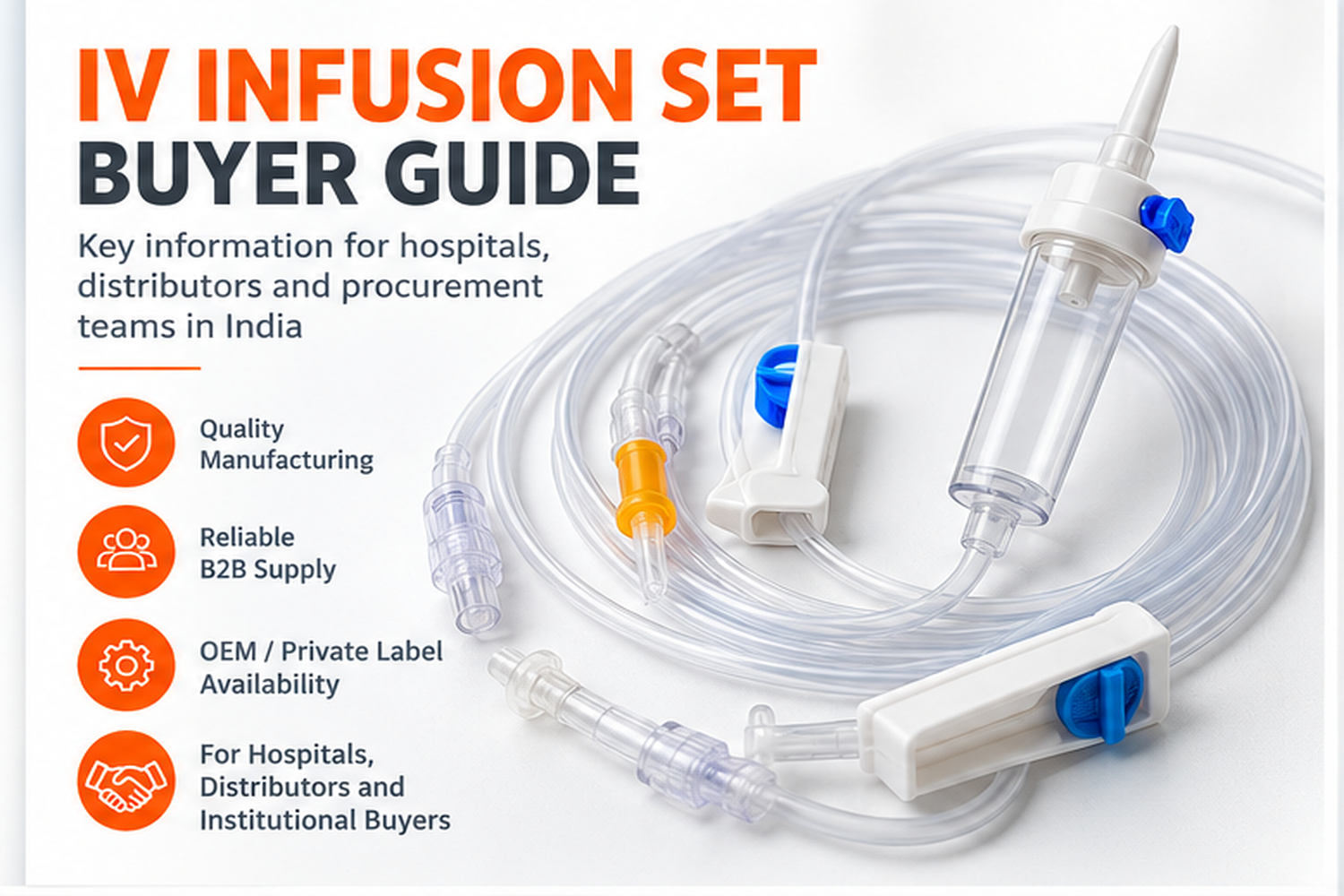

IV Infusion Set Types & Bulk Buying Guide for Hospitals in India
A practical B2B guide to IV set variants, specifications, documentation and bulk sourcing for hospitals, distributors and tender buyers in India.
For hospital purchasing teams, medical distributors and tender buyers, an IV infusion set is more than a generic line item. A request for an “IV set,” “IV giving set,” “IV drip set” or “intravenous administration set” may refer to different connector, spike, venting and access-port configurations. Ordering the wrong variant can cause avoidable clarification, substitution or compatibility problems even when the quoted price looks attractive.
This guide explains how to compare IV infusion set types and prepare a clear bulk request for quotation in India, including Kerala. It is written for B2B procurement, not as instructions for administering an infusion. Clinical selection, device compatibility and use must remain with qualified healthcare professionals following current product instructions and institutional protocols.
Why “IV set,” “IV drip set” and “infusion set” need clarification
These phrases are frequently used as search and purchasing synonyms. They do not define the exact product. An IV administration set can differ in spike and air-vent configuration, connection type, presence of an injection site, drip characteristics and packaging. An accurate purchasing description therefore starts with the generic product name and adds the features required by the hospital or tender specification.
For documented variants, review Sicher Medik’s Neofluss® IV infusion set range. The manufacturer identifies four configurations: Neofluss®, Neofluss® Vent, Neofluss® Plus and Neofluss® Micro. Their current technical sheets, rather than a broad category label, should determine suitability for a particular order.
1. Compare the main IV infusion set configurations
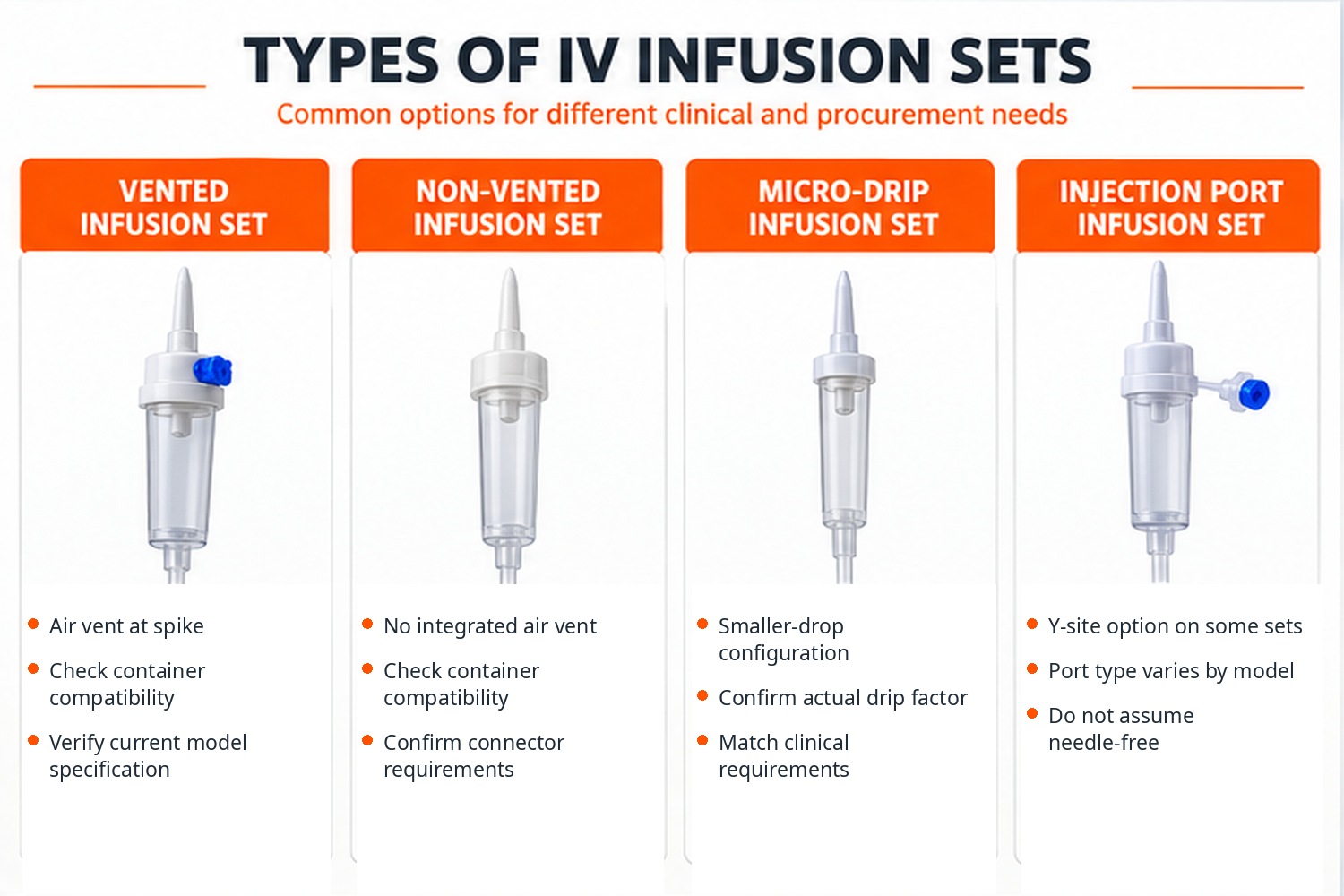
Non-vented IV infusion set
A non-vented configuration has no integrated air vent at the spike. Container compatibility must be checked against the fluid container and the manufacturer's instructions; a buyer should not assume every bag, bottle or delivery system works with the same spike. The documented Neofluss® standard configuration includes a non-vented sharp spike, bulb latex with adaptor and 24 G needle. This is a specific listed configuration, not a feature of every IV set.
Vented IV infusion set
A vented spike includes an air-vent feature that may be relevant to certain container systems. “Vented” does not automatically mean universally compatible or clinically preferable. Neofluss® Vent is documented with a vented sharp spike and Luer lock. Procurement teams should confirm vent configuration, connection requirements and the current product specification before approval.
IV infusion set with injection port
Some requirements specify a Y-site or injection port. Buyers should identify the exact port type and its documented compatibility, rather than treating “injection port” and “needle-free connector” as equivalent terms. Neofluss® Plus is documented with a vented sharp spike, Y injection port and Luer lock. Do not infer needle-free access or other safety mechanisms unless they are explicitly specified for the exact model.
Micro-drip IV infusion set
A micro-drip configuration is a distinct option when a smaller-drop delivery system is required by the clinical specification. Neofluss® Micro is identified as a micro-drip spike configuration. Confirm the actual drip factor from the current technical sheet; a generic industry figure should never be copied into a tender response as if it were verified for this model.
2. Know when a different administration set is required
Not every infusion-related purchase is a standard IV set. A paediatric burette set is a measured-volume system; Sicher Medik's Pediafluss® documentation lists 100 ml and 150 ml chambers and a 60 drops/ml micro-drip system. A blood transfusion set is a separate blood-administration product with a documented filtration configuration. These should not be substituted for an ordinary IV giving set solely because the tubing looks similar.
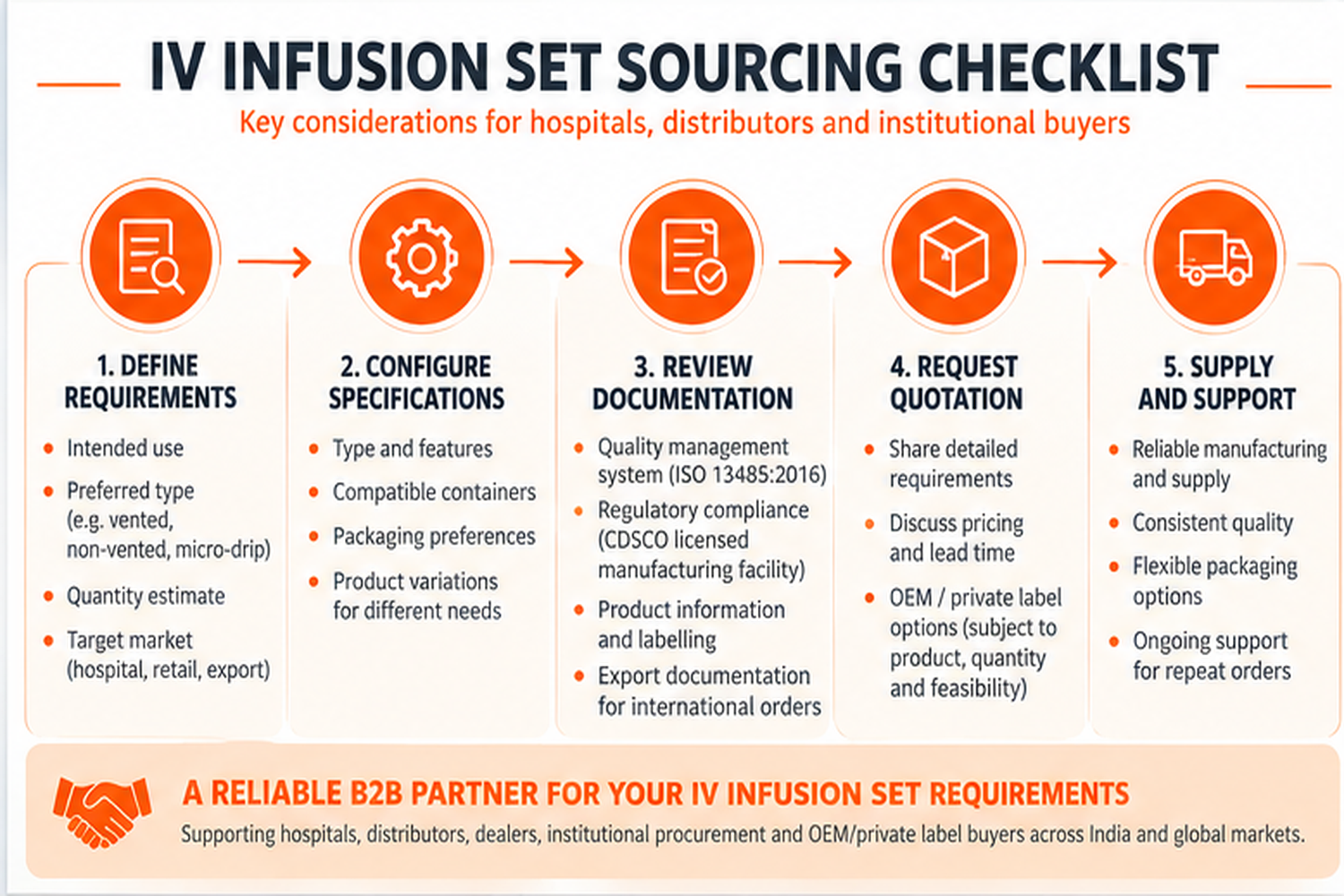
3. Build a specification checklist before requesting a quotation
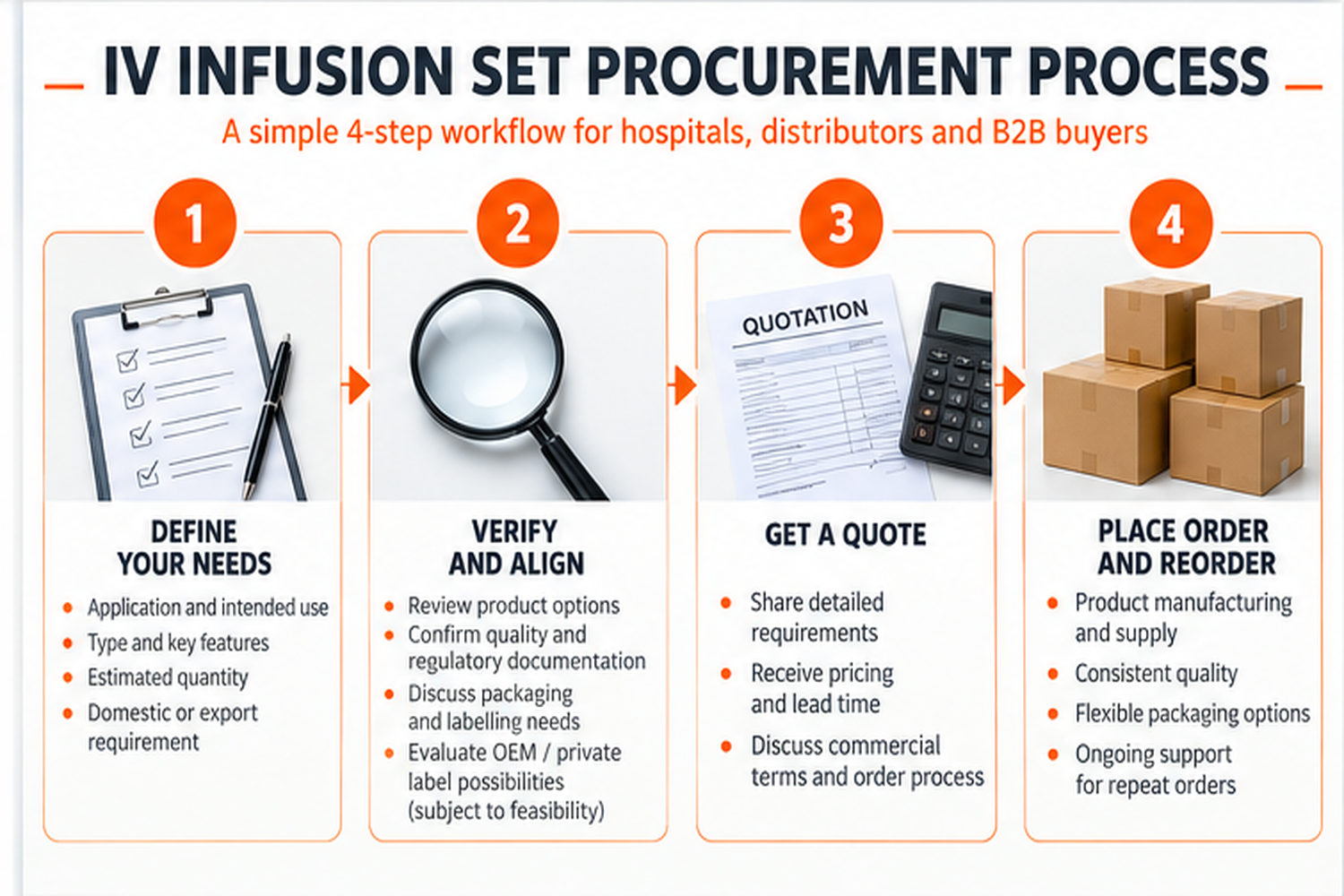
Hospital procurement teams can reduce avoidable revisions by recording the intended clinical department, the exact generic device description, required spike/vent configuration, connector type, injection-site requirement, drip factor where specified, sterile and single-use requirements, pack format, quantities and delivery schedule. Add any current tender-specific testing or documentation requirements.
Use the same checklist for supplier comparison. A price quotation without the matching model and technical description may be impossible to evaluate fairly. If a supplier offers an alternative configuration, request the differences in writing and obtain appropriate clinical and technical approval before accepting a substitution.