Sterile Barrier Packaging for Medical Devices: Buyer Guide

What hospital, distributor and OEM buyers should verify about sterile packs, sealing, labelling, shelf-life documentation and transport.

For sterile medical devices, packaging is part of the product system—not a decorative afterthought. Hospital buyers, distributors, OEM customers and tender teams should understand what a sterile barrier system is intended to do, which packaging claims need evidence, and why pack integrity, sealing, labelling, transport and shelf-life documentation should be checked before large orders.

This guide focuses on procurement and supplier evaluation. It does not claim that Sicher Medik uses any specific barrier material such as Tyvek®, medical paper, blister or pouch for every product. The exact packaging system should always be confirmed from the current product documentation.

What is a sterile barrier system?

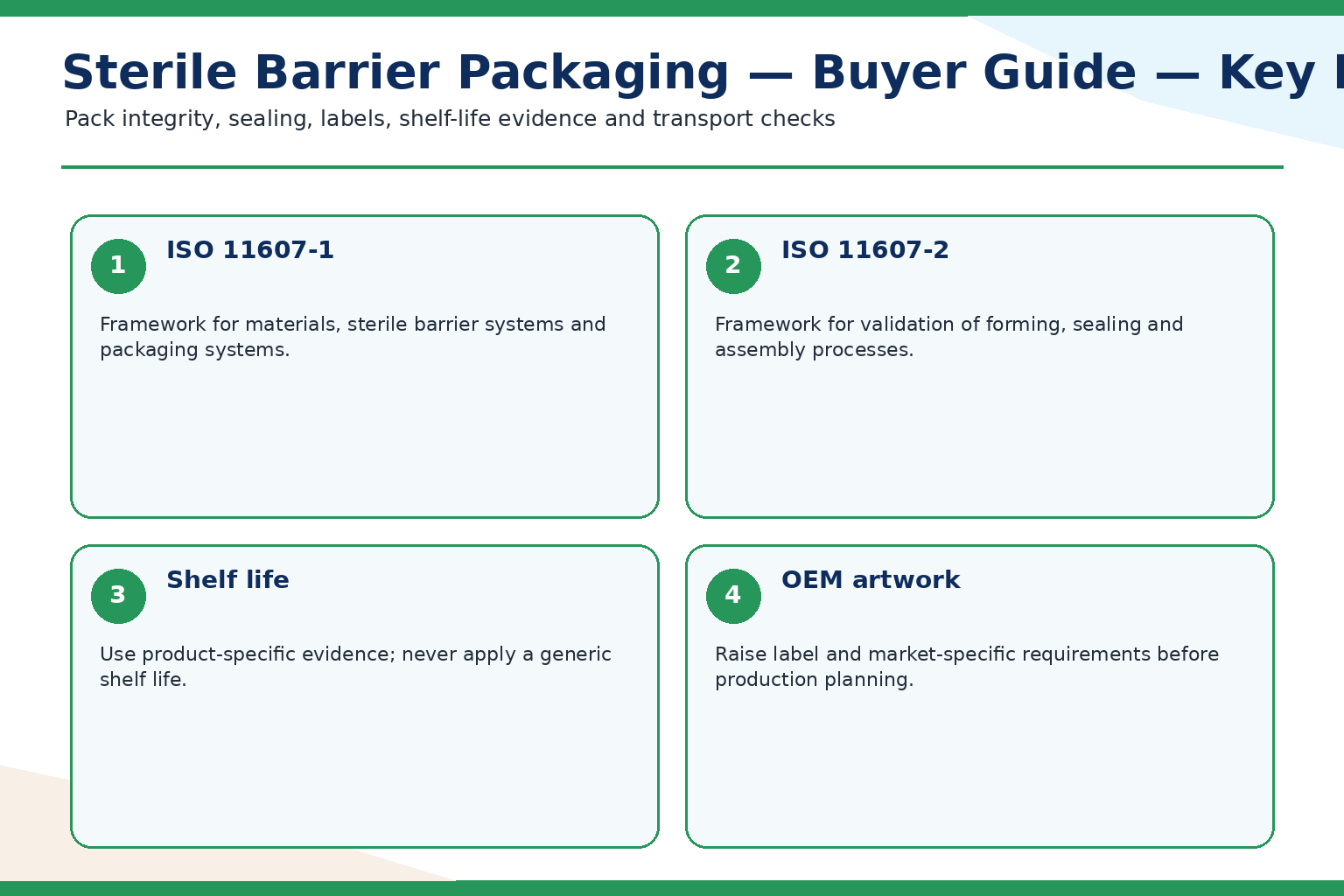
ISO 11607-1 addresses materials, preformed sterile barrier systems, sterile barrier systems and packaging systems intended to maintain sterility of terminally sterilized medical devices until the point of use. ISO 11607-2 addresses validation of forming, sealing and assembly processes for those packaging systems.

For buyers, the practical lesson is simple: “sterile” is not only a device label. The package, closure and sealing process are part of maintaining the sterile state through storage and distribution until opening.

1. Ask what packaging system applies to the exact product

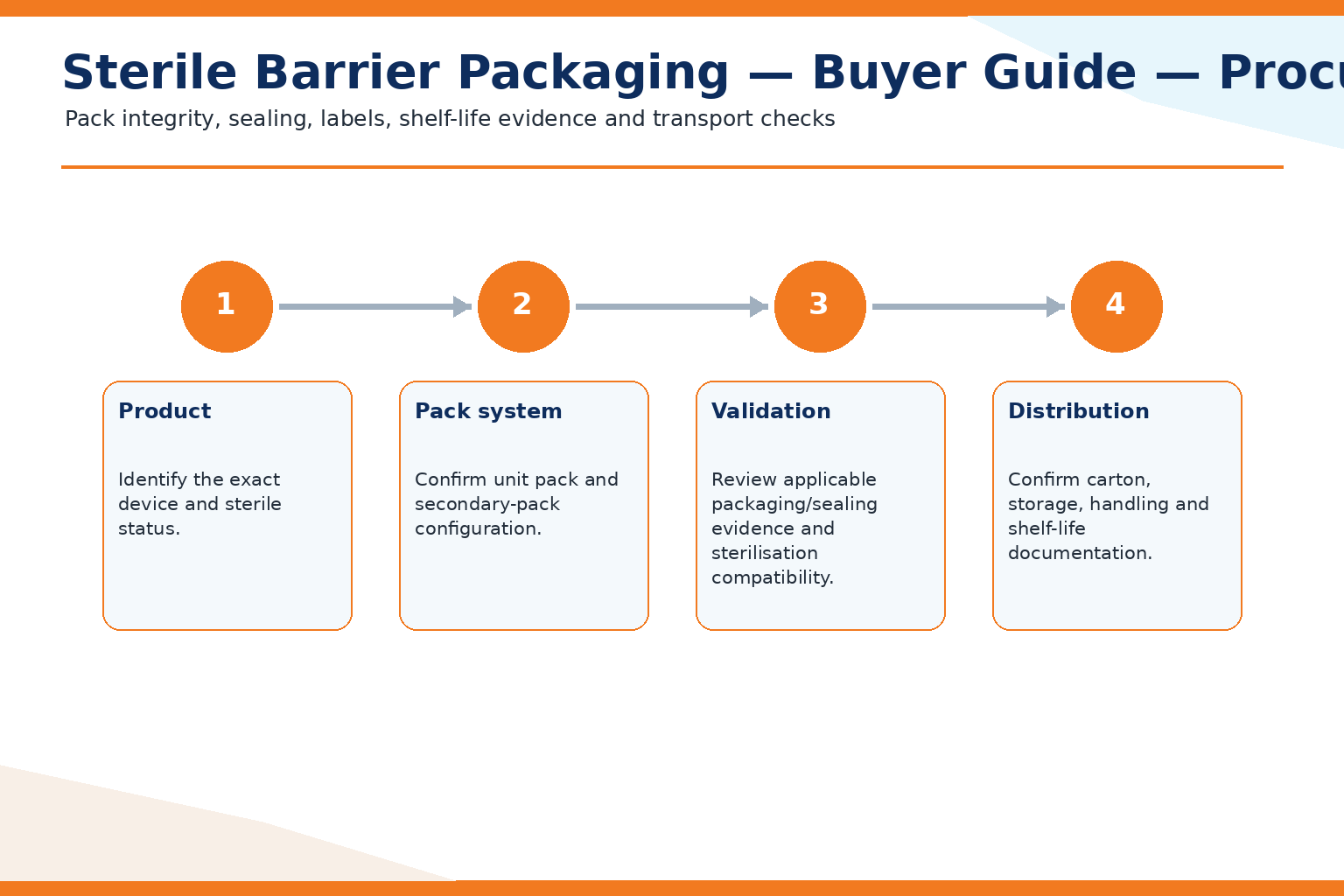
Different medical devices may use different package formats based on size, geometry, sterilisation method, barrier requirements, transport conditions and manufacturing process. A tender should therefore avoid assuming that one material or format is universal across a manufacturer’s catalogue.

Instead, ask for the current pack configuration, unit pack, secondary pack and carton details for the exact product being ordered.

2. Separate material names from validated performance

Terms such as medical paper, film, pouch, blister or Tyvek® describe materials or formats, but they do not by themselves prove that the final package is suitable for a particular device or sterilisation process. Buyers should avoid specifying a branded or generic material solely because it is familiar unless there is a justified technical requirement.

The relevant question is whether the complete packaging system and sealing process are appropriate and supported by the manufacturer’s documented validation and quality controls.

3. Check pack integrity and seal expectations

For institutional procurement, the technical specification can include requirements for intact packaging, visible product identification, appropriate sealing, lot/batch traceability and any required expiry or manufacturing information. If a tender requires specific package-integrity or seal-strength evidence, request the current validated documentation rather than inventing a generic acceptance value.

4. Confirm sterilisation and packaging compatibility

Packaging for a terminally sterilized device must be compatible with the applicable sterilisation process and the device itself. The exact method and package configuration should be verified from current product documentation. Do not assume that a package used for one sterilisation method is automatically appropriate for another.
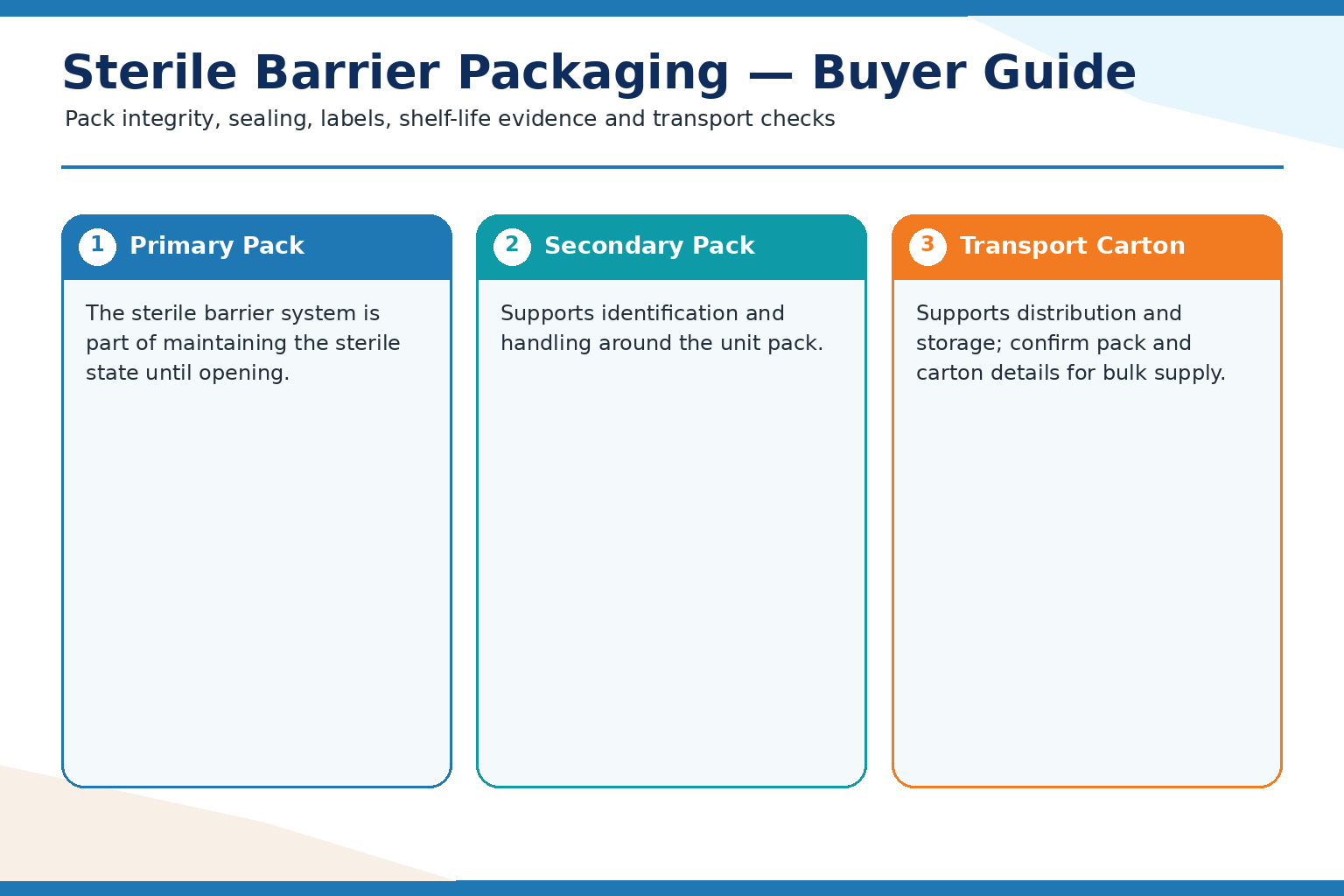
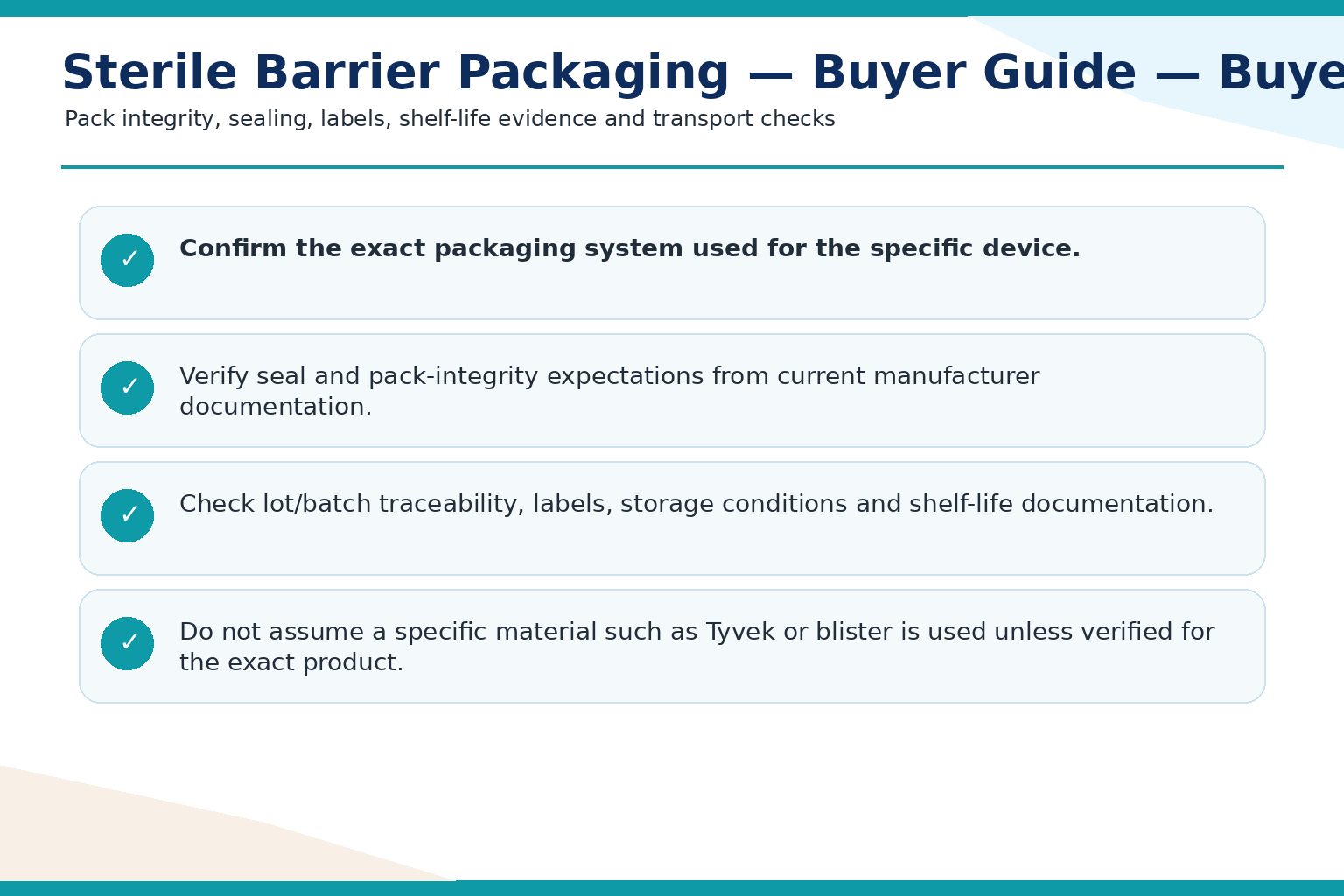
Sterile barrier packaging procurement infographic for medical devicesSterile medical device packaging buyer checklist for integrity labels and shelf-life evidence

5. Shelf life should be documented, not guessed

Shelf life depends on the validated product and packaging system, storage conditions and supporting stability or package-integrity evidence. Procurement teams should request the current labelled shelf life or approved documentation for the exact product rather than applying a generic number across all sterile consumables.

6. Transport packaging matters for B2B supply

For hospital chains, distributors and export buyers, the sterile unit pack sits inside a larger logistics system. Secondary packs and cartons should support handling, identification and distribution without creating unnecessary risk to the primary package. Large orders should confirm carton quantity, pack orientation where relevant, storage guidance and any special handling instructions.

This becomes especially important for pan-India and export shipments where products may pass through multiple warehouses, transport conditions and receiving points.

7. Labelling and traceability belong in the procurement checklist

A strong RFQ can include the exact product name, model, sterile status, unit-pack requirement, secondary-pack requirement, carton quantity, lot/batch traceability, label information, expiry or shelf-life documentation where applicable, storage conditions and required regulatory statements.

OEM and private-label buyers should raise artwork, branding and market-specific label requirements before production planning because packaging changes may require technical and regulatory review.

8. Avoid unsupported “sterile barrier” marketing claims

Procurement language should distinguish between verified package characteristics and promotional wording. Do not claim that a particular material guarantees sterility, extends shelf life or survives a specific climate or transport condition unless those statements are supported by product-specific evidence.

9. Use ISO 11607 correctly

ISO 11607-1:2019 remains a current international standard for sterile barrier and packaging-system requirements for terminally sterilized medical devices, with a 2023 amendment on application of risk management. ISO 11607-2:2019 remains current for validation requirements for forming, sealing and assembly processes.

These standards provide a useful reference framework, but a buyer should still verify the exact manufacturer documentation applicable to the device being procured.

Frequently asked questions

What does a sterile barrier system do?

It is intended to allow sterilisation and maintain the sterile condition of a terminally sterilized medical device until the point of use, subject to the validated packaging system and handling conditions.

Does every sterile medical device use the same packaging material?

No. Packaging systems vary by device, sterilisation method, design and validated manufacturing process.

Can a tender specify Tyvek® for every sterile disposable?

Only if there is a justified, applicable technical requirement. Buyers should not assume that a branded material is necessary or used for every product.

What packaging details should a hospital request?

Confirm unit pack, secondary pack, carton details, label information, lot/batch traceability, sterile status, shelf-life documentation where applicable and storage/handling requirements.

Does ISO 11607 prove the shelf life of a specific product?

No. Shelf life must be supported by the manufacturer’s product- and packaging-specific evidence. ISO 11607 provides packaging-system requirements and validation framework.

Sterile barrier packaging procurement workflow from device to distributionKey sterile packaging procurement points including ISO 11607 and shelf-life documentation

Conclusion: treat packaging as part of the medical device system

For sterile medical-device procurement, the package is part of maintaining product integrity from manufacturing through distribution to point of use. Buyers should verify the exact packaging configuration, sealing and validation evidence, labelling, traceability, shelf-life documentation and transport requirements for the device being ordered.

Sicher Medik B2B buyers can request current product-specific packaging information, bulk packing details and eligible OEM/private-label packaging options when preparing hospital, distributor or export orders.