
Paediatric Burette Set Procurement Guide for Hospitals in India
100 ml vs 150 ml chambers, micro-drip specifications, sterile supply and tender checks for institutional buyers.
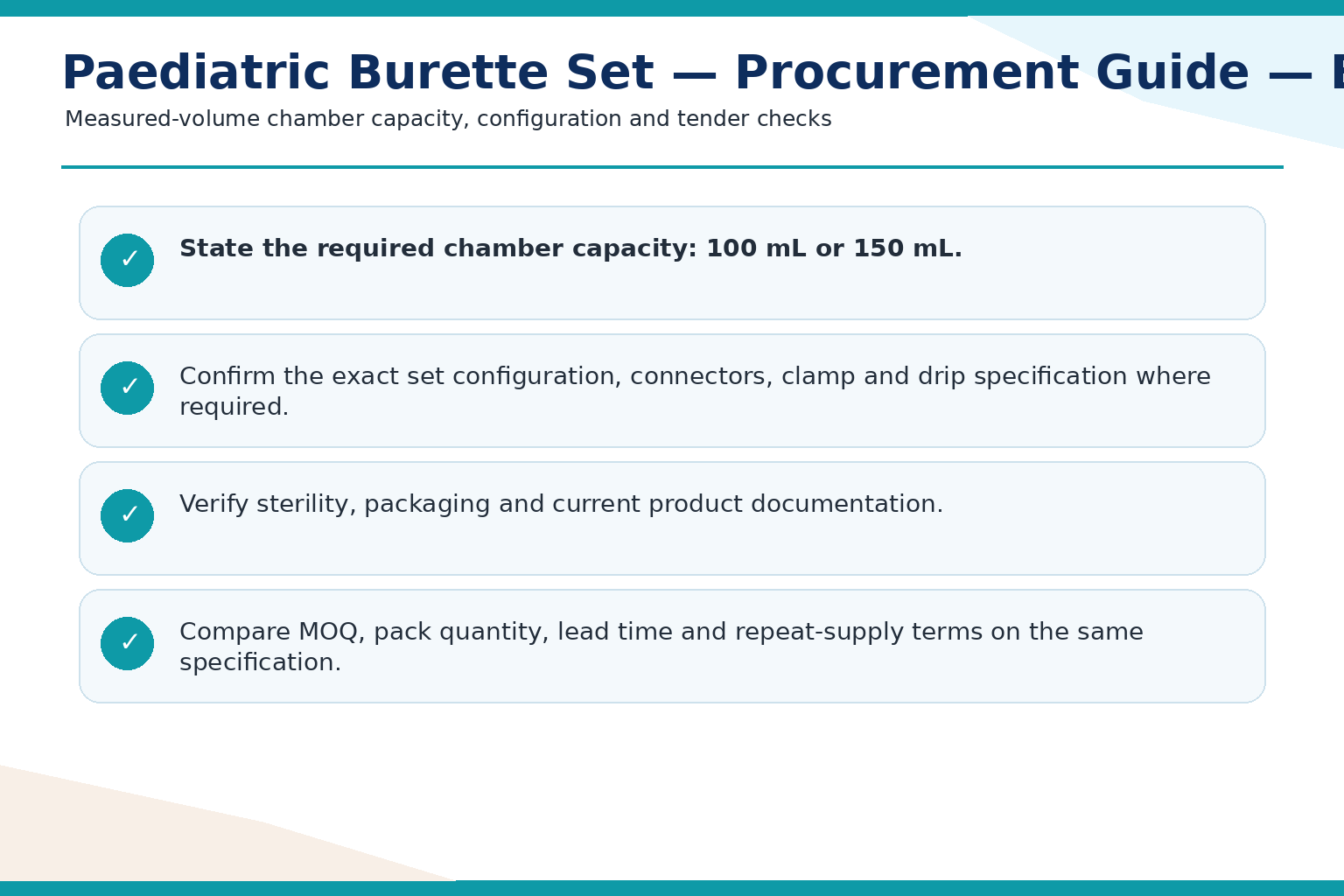
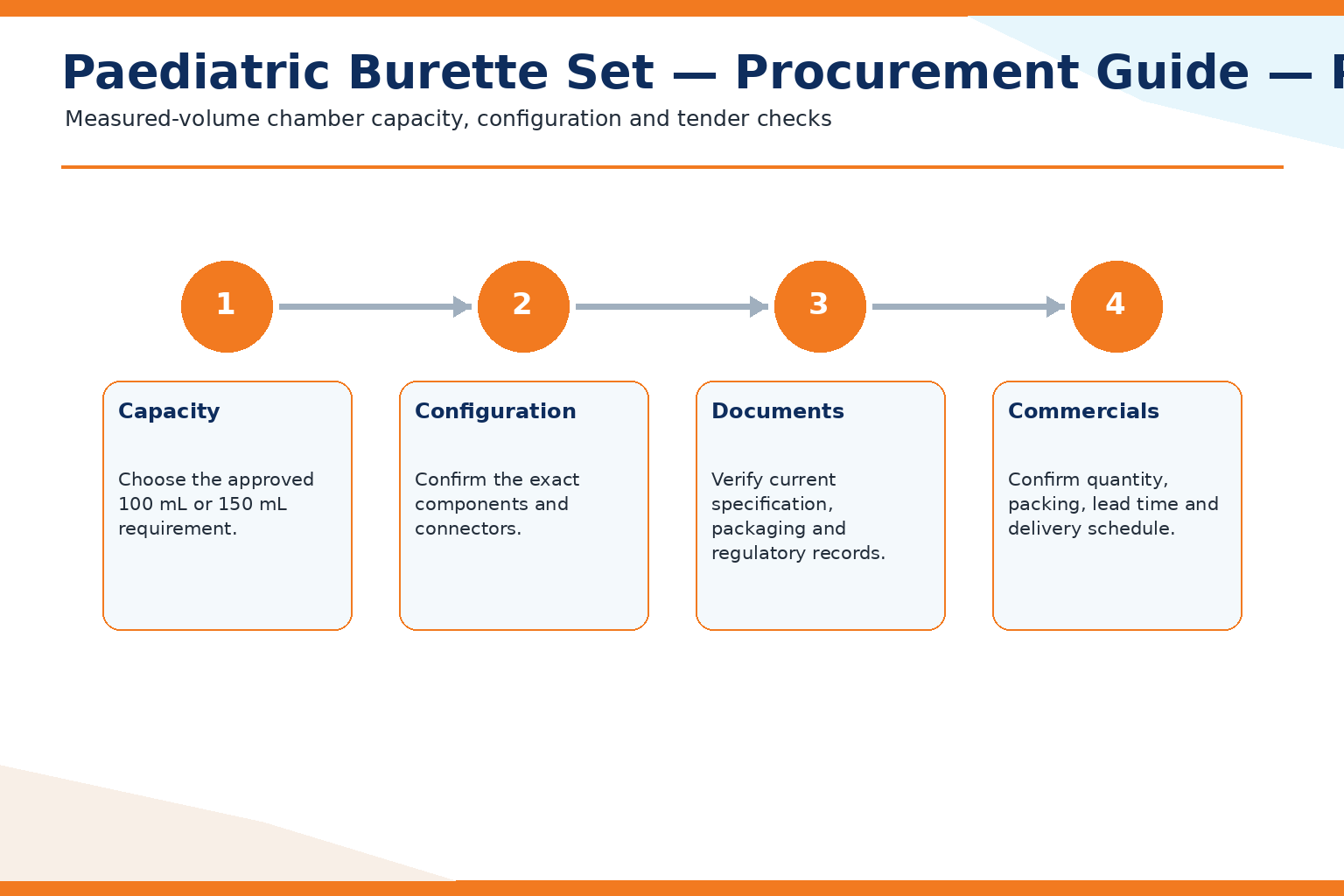
For hospitals, distributors and institutional buyers in India, a paediatric burette set purchase should start with a clearly documented device configuration, not simply a unit price. Also called a measured-volume infusion set or volume-control IV set, the product includes a graduated chamber used by trained professionals as part of prescribed infusion therapy. Buyers need to identify the approved chamber capacity, drip specification, connections, supplied assembly, sterility, packaging and documents before comparing offers.
This is a purchasing guide, not instructions for clinical infusion rates, dosing or patient selection. Clinical use must follow the device instructions, the prescribing clinician and hospital protocols.
What is a paediatric burette infusion set?
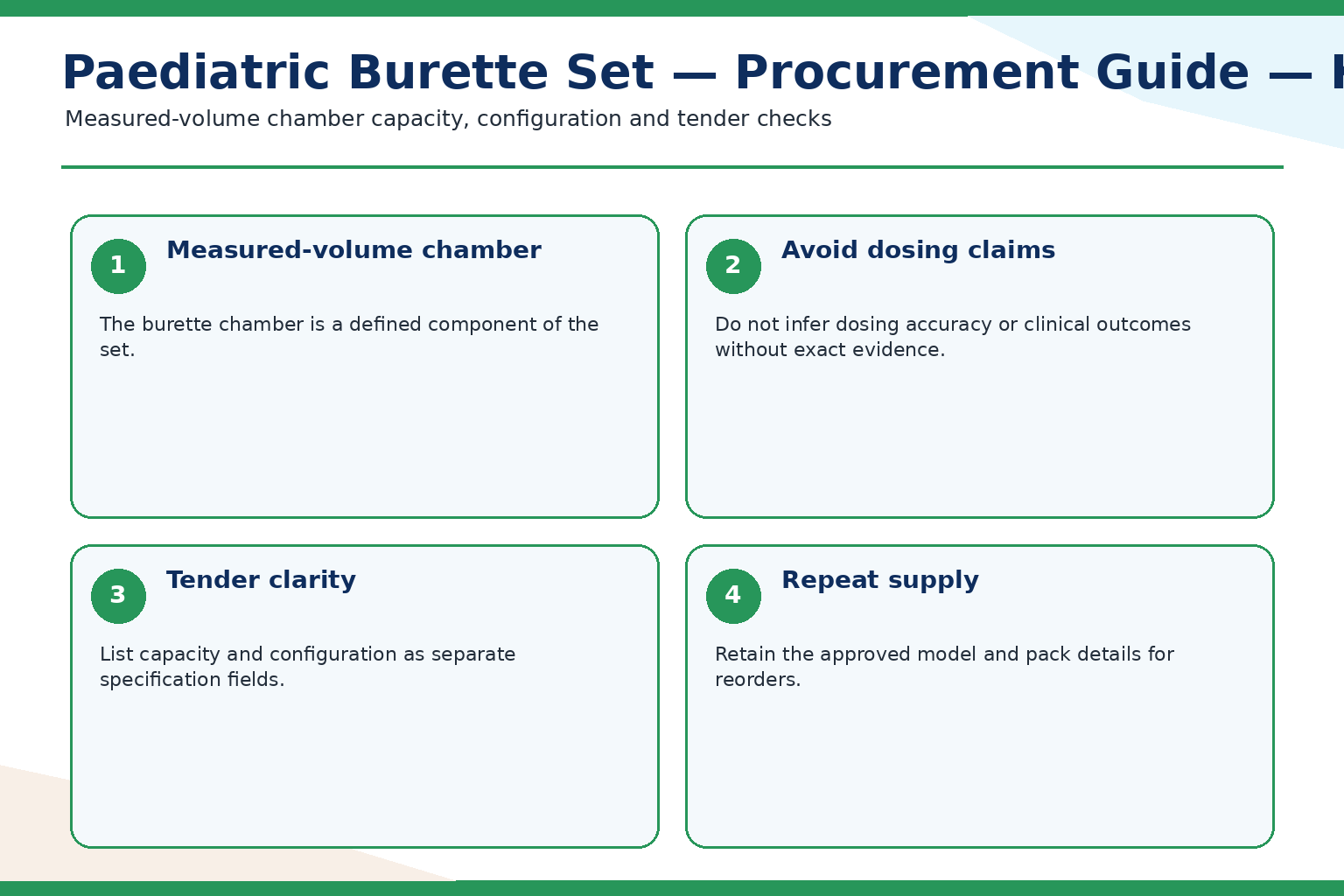
A burette set is an IV administration assembly with a graduated fluid chamber. It differs from a conventional IV giving set because the chamber is a key part of the specified product configuration. In an RFQ, identify the generic product as “paediatric burette infusion set” and add “measured-volume IV set” as a search synonym when useful. Do not assume that every product described with those terms has the same components or connections.
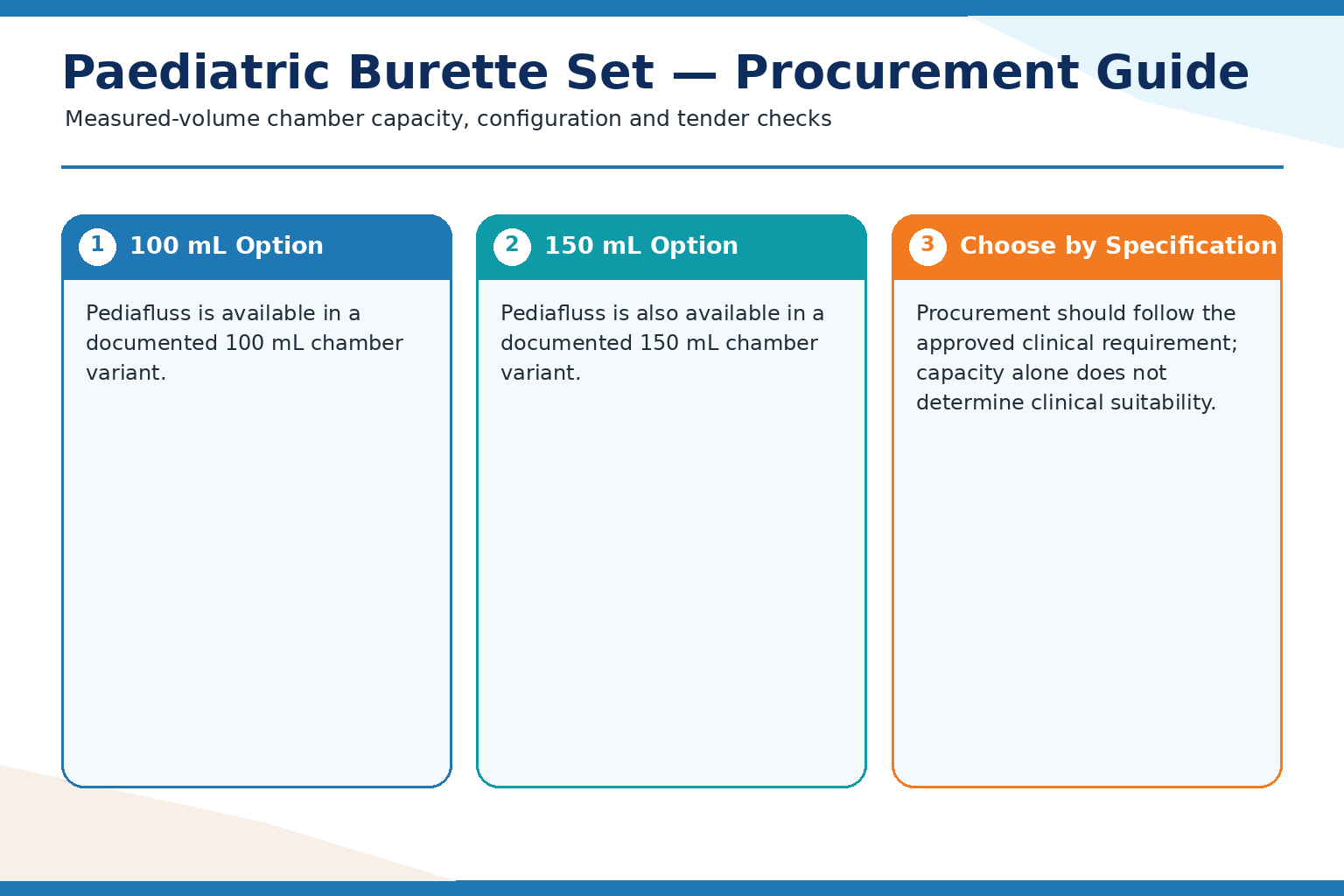
Sicher Medik's Pediafluss® paediatric burette set currently lists 100 ml and 150 ml graduated chamber options, a 60 drops/ml micro-drip specification, an automatic shut-off float valve, a Y-injection site and an air-vented spike. The listed product is sterile and single use. These are attributes of this documented range, not universal specifications for every competitor product.
1. Specify 100 ml or 150 ml chamber capacity
Chamber capacity should appear as a separate field on every purchasing line. If departments use different approved capacities, maintain separate SKUs and purchase-order descriptions. This makes stock receiving and repeat purchasing more consistent. Ask the clinical or biomedical team to approve the requested configuration before the tender is issued.
Chamber capacity does not establish a clinical dose, flow rate or suitability for a particular patient. Procurement teams should avoid making those conclusions from marketing descriptions. For Pediafluss®, the documented capacity choices are 100 ml and 150 ml; availability and exact current configuration should be confirmed with the quotation.
2. Record the micro-drip specification accurately
“Micro-drip” is a useful search term, but it is not sufficient as a tender specification. Pediafluss® currently documents a 60 drops/ml micro-drip system. Record that figure only when it is required for the approved model, and confirm it from the current product information. Never treat the nominal drop factor alone as proof of clinical dosing accuracy or a guaranteed delivered rate.
Where hospitals compare competing bids, request the manufacturer's current specification for the exact quoted model. A generic IV set, micro-drip set and burette set may be offered as different products; their quotations should not be treated as equivalent merely because they all belong to the infusion category.
3. Review the chamber and valve assembly
Buyers should ask whether the quoted set includes the graduated chamber and the components described in the approved specification. Pediafluss® lists an automatic shut-off float valve. The purchasing team should verify that the delivered item matches the documented design, without inferring any unsupported protection against air embolism or other clinical outcome.
Sample review can document visibility of graduations, component identification, packaging and the assembly supplied. Functional or clinical acceptance criteria belong to the qualified technical team and the manufacturer's evidence.
4. Confirm spike, injection site and connections
The current Pediafluss® description includes an air-vented spike and Y-injection site. Those details matter when preparing a like-for-like quotation comparison. Record any additional connection requirements approved by the hospital and request compatibility evidence when needed. Do not assume an unspecified Luer type, needle arrangement or tubing dimension.
Where a hospital already purchases standard IV infusion sets, use separate product codes for those and burette sets. Similar packaging or supplier names should not cause the two categories to be substituted.